
Harmful Algal Blooms
Harmful algal blooms result from noxious and/or toxic algae that cause direct and indirect negative impacts on aquatic ecosystems, coastal resources, and human health (Kudela et al., 2015).
Primary reference(s)
Kudela, R., Berdalet, E., Bernard, S., Burford, M., Fernand, L., Lu, S., Roy, S., Usup, G., Tester, P., Magnien, R., Anderson, D., Cembella, A., Chinain, M., Hallegraeff, G., Reguera, B., Zingone, A., Enevoldsen, H., Urban, E., 2015. Harmful Algal Blooms. A scientific summary for policy makers. Accessed 12 February 2025.
Annotations
Additional scientific description
Harmful algal blooms (HABs) are present in nearly all aquatic environments (freshwater, brackish, marine), as naturally occurring phenomena (Kudela et al., 2015).
Many HABs are increasing in severity, frequency, and biogeographical range. Causes are complex, but in some cases can be attributed to climate change and human impacts, including eutrophication, habitat modification, and human-mediated introduction of exogenous species (Kudela et al., 2015).
Photosynthetic algae support healthy aquatic ecosystems and form the base of the food web, fixing carbon and producing oxygen. Under certain circumstances, some species can form high-biomass and/or toxic proliferation of cells (or 'blooms'), thereby causing harm to aquatic ecosystems, including plants and animals, and to humans via direct exposure to water-borne toxins or toxic seafood consumption. Ecosystem damage by high-biomass blooms may include disruption of food webs, fish-killing by gill damage, or contribution to low oxygen 'dead zones' after bloom degradation. Some HAB species also produce potent natural chemicals (toxins) that can persist in the water or enter the food web, leading to illness or death of aquatic animals and/or human seafood consumers (Kudela et al., 2015).
Even non-toxic algal blooms can have devastating impacts when they lead to kills of fish and invertebrates by generating anoxic conditions. Some algal species, although non-toxic to humans, can produce exudates that cause damage to the delicate gill tissues of fish (such as the raphidophytes Chattonella, Heterosigma, and dinoflagellates Karenia, Karlodinium). Aquaculture stocks (caged fish, molluscs, crustaceans) are trapped and, thus, can suffer devastating mortalities, which could lead to economic and food losses and may eventually become a food security issue (FAO & WHO, 2020).
Of greatest concern to human society are algal species that produce potent neurotoxins that can find their way through shellfish and fish to human consumers, where they cause a variety of gastrointestinal and neurological illnesses (FAO, 2012).
Metrics and numeric limits
Various systems are available and used to assist in determining HAB toxicity. These include:
- National Centers for Coastal Ocean Science (NCCOS) of the US National Oceanic and Atmospheric Administration (NOAA) developed the Algal Bloom Monitoring System to routinely deliver near real-time products for use in locating, monitoring and quantifying algal blooms in coastal and lake regions of the U.S. This application delivers a suite of bloom detection products in the form of geographic-based images (NCCOS, no date).
- The Centre for Environment, Fisheries and Aquaculture Science is an executive agency of the United Kingdom government's Department for Environment, Food and Rural Affairs. CEFAS runs a Harmful Algal Blooms (HABS) Surveillance Programmes and Monitoring aims to identify algae in blooms that may produce potent biotoxins which can accumulate in filter-feeding bivalve molluscs and sometimes in other shellfish, such as grazing gastropods. The results of the FSA/FSS biotoxin and phytoplankton monitoring programmes are published weekly (CEFAS, no date).
Key relevant UN convention / multilateral treaty
Not identified.
Drivers
It is difficult to predict when a HAB will develop. Climatic and environmental conditions such as changes in salinity, rising water temperature, and increased nutrient levels and sunlight can influence population growth for HAB species. In some cases, these changes can be attributed to human impacts, including habitat modification, and human-mediated introduction of exogenous species (NOAA, 2016).
Impacts
Many islands and countries in arid regions, where freshwater resources are limited, are increasingly dependent on desalination to provide water to rapidly growing coastal populations and to meet the social and economic demands that underpin development in those areas. Evidence is now showing that HABs pose a threat to the desalination industry and to water security in those areas. Studying HABs in the vicinity of desalination plants is an emerging science because there is limited information on the potential problems that toxic blooms may pose (UNESCO, 2015).
Multi-hazard context
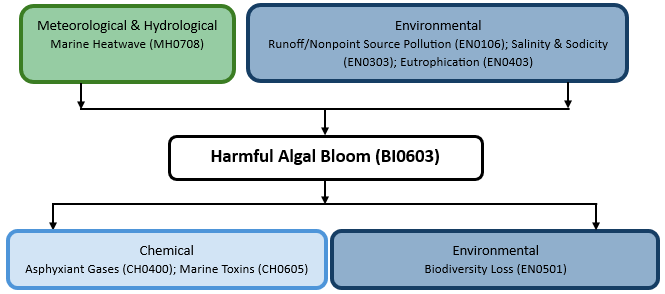
The figure below summarises common interactions between harmful algal blooms and other hazards. This information should be used with caution and not be solely relied upon in Disaster Risk Management, particularly as some interactions may not have been included. Note that hazardous events occurring together or locally in space or time may not necessarily cause, amplify, or be otherwise related to each other. Specific examples of multi-hazard context can be found in the ‘Hazard drivers’ and ‘Impacts’ sections above.
Multi-hazard diagram
Risk Management
Harmful algal blooms are recognised as one facet of complex ecosystem interactions with human society. Research, monitoring, and management of HABs must be closely integrated with policy decisions that affect the global oceans (Kudela et al., 2015). The Intergovernmental Oceanographic Commission (IOC-UNESCO) has been a driver in defining the international research agenda on HABs and their impacts and is now also addressing how to provide solutions applicable to desalination plants (UNESCO, 2015).
There is no plan and no realistic possibility of eliminating HABs and/or their dependent consequences. Nevertheless, decades of research and monitoring have improved the understanding of HAB events, leading to better monitoring and prediction strategies (Kudela et al., 2015).
Harmful algal blooms are a worldwide phenomenon requiring an international understanding leading ultimately to local and regional solutions. Continued progress in research, management, mitigation, and prediction of HABs benefits from international coordination. In this spirit, the international community has developed programmes sponsored by the IOC and Scientific Committee on Oceanic Research (SCOR) to coordinate international HAB research, framework activities, and capacity building (Kudela et al., 2015).
New technologies and approaches to monitoring, control and management of HABs are now available, highlighting molecular probes for cell detection, rapid and sensitive toxin assays, remote sensing detection and tracking of blooms, bloom control and mitigation strategies, and the use of large-scale physical/biological models to analyse past blooms and forecast future events (Anderson, 2009).
New initiatives, such as GlobalHAB sponsored by IOC and SCOR, will continue to provide the mechanisms to further understand, predict, and mitigate HABs. Research, management, and mitigation efforts directed towards HABs must be coordinated with other local, national, and international efforts focused on food and water security, human and ecosystem health, ocean observing systems, and climate change (Kudela et al., 2015).
The establishment of national monitoring programmes for marine biotoxins and their source organisms (HABs) is needed. These programmes require continuous update to include new and emerging toxins when necessary and for harvesting area management.
Monitoring
The section and the table below offer an overview of monitoring for harmful algal blooms. This information can be used for forecasting within a national early warning system (EWS). Since EWS capacities and processes differ across countries, the most current and specific information regarding EWS should be obtained from the appropriate national or regional agency/authority responsible for disaster management.
| Which institution(s) produce(s) Disaster Risk Data/Information? | Centres that develop and implement monitoring systems can operate under different competent authorities covering both food safety control and environment. |
| How is the Hazard Observed/Monitored/Forecast? | Monitoring systems and early warning systems for marine biotoxins and HABs |
References
Anderson, D.M., 2009. Approaches to monitoring, control and management of harmful algal blooms (HABs). Ocean & Coastal Management, 52:342. doi:10.1016/j.ocecoaman.2009.04.006
CEFAS, no date. A Harmful Algal Blooms (HABS) Surveillance Programmes and Monitoring. Centre for Environment, Fisheries and Aquaculture Science (CEFAS). Accessed 28 May 2025.
FAO, 2012. The State of World Fisheries and Aquaculture. Food and Agriculture Organization of the United Nations (FAO). Accessed 12 February 2025.
FAO and WHO, 2020. Report of the Expert Meeting on Ciguatera Poisoning. Rome, 19–23 November 2018. Food and Agriculture Organization of the United Nations (FAO) and World Health Organization (WHO). Accessed 12 February 2025.
Kudela, R., Berdalet, E., Bernard, S., Burford, M., Fernand, L., Lu, S., Roy, S., Usup, G., Tester, P., Magnien, R., Anderson, D., Cembella, A., Chinain, M., Hallegraeff, G., Reguera, B., Zingone, A., Enevoldsen, H., Urban, E., 2015. Harmful Algal Blooms. A scientific summary for policy makers. Accessed 12 February 2025.
NCCOS, no date. Harmful Algal Bloom Monitoring System. National Centers for Coastal Ocean Science (NCCOS). Accessed 28 May 2025.
NOAA, 2016. What is a Harmful Algal Bloom? National Oceanic and Atmospheric Administration (NOAA). Accessed 12 February 2025.
UNESCO, 2015. Addressing the impacts of Harmful Algal Blooms on water security. Accessed 12 February 2025.