

Youth foresight sprint: Investing in resilient futures’
To mark the International Day for Disaster Risk Reduction (IDDRR) 2025, UNDRR and UNU invited universities worldwide to take part in the Youth Foresight Sprint: Investing in Resilient Futures.
Through this initiative, students and researchers created national foresight scenarios showing how the future could unfold under specific risks—or cascading risks—and what actions today can build a more resilient tomorrow.
Turning the tide: Climate action in the Coral Triangle (Indonesia and the Pacific)
Texas Tech University, United States
This foresight scenario examines how sea level rise could devastate the Coral Triangle—often called the “Amazon of the Ocean”—by 2050. The analysis shows how unchecked ocean rise might submerge densely populated regions and proposes transformative climate actions, aligned with the Global Assessment Report 2025, to avert the loss.
What if a warning we ignored in 2047 became a global crisis by 2050? (Global)
UK Health Security Agency, United Kingdom
This foresight scenario envisions a new strain of hantavirus emerging in 2050, triggering a worldwide health emergency. The team explores the drivers of the crisis and recommends resilience measures across policy, infrastructure, and behaviour to strengthen global health systems.
A hungry future? Global food insecurity and Sri Lanka’s story (Sri Lanka)
University of Huddersfield – Disaster Resilience Centre, United Kingdom
This scenario focuses on the growing threat of food insecurity in Sri Lanka—a challenge mirrored across the world. The foresight highlights climate shocks, rising food costs, and other systemic risks, while proposing strategies for building sustainable and equitable food systems by 2050.
Anticipating earthquake systemic disaster risks in Mexico City (Mexico)
National University of Mexico (UNAM)
This foresight scenario envisions an extreme earthquake striking Mexico City, rippling through interconnected systems such as infrastructure, health, and economy. The analysis identifies unplanned urban growth and climate change as key amplifiers of risk and offers recommendations to strengthen preparedness and resilience.
Disproportionate flood impacts within the United States (United States)
Columbia University, United States
This foresight scenario models how extreme floods could inundate 38 major U.S. coastal cities by 2050, leading to widespread displacement, homelessness, and gentrification. The team proposes integrated policy, structural, and financial solutions to enhance resilience and social equity.
Informal settlements facing fire, flood, and landslide hazards (South Africa)
North-west University, South Africa
This scenario examines overlapping hazards—fires, floods, and landslides—affecting informal settlements in South Africa. It challenges the “natural disaster” narrative and calls for equity-driven, inclusive urban planning and resilient infrastructure to break cycles of vulnerability.
Sustainable energy from food waste: Reducing carbon emissions through biogas (Azerbaijan)
Azerbaijan State University of Economics
Focusing on sustainable energy futures, this foresight traces how methane emissions from food waste drive air pollution and climate change. The scenario promotes circular economy approaches such as biogas production to reduce emissions and improve energy security.
Compound volcanic–wildfire events (Global)
University of Leeds, United Kingdom
This foresight scenario investigates the domino effect of compound disasters—how volcanic eruptions can trigger wildfires, worsen air pollution, and accelerate planetary heating. The team’s recommendations cover preparedness, response, and recovery to mitigate cascading risks.
Mega fires and risks to informal settlements (Chile)
Universidad de Chile – Faculty of Architecture and Urbanism, Chile
This scenario explores how climate change, ecosystem degradation, and migration-driven urban growth increase the risk of mega fires in Chile. The team proposes economic incentives, reconstruction measures, and public awareness campaigns to strengthen community resilience.
Strengthening urban resilience: Governance pathways for flood risk reduction (South Africa)
Durban University of Technology, South Africa
Focusing on climate risk governance, this foresight outlines how weak land use regulation and underinvestment in infrastructure heighten flood vulnerability. The scenario recommends strengthening municipal councils and enhancing investment transparency to build urban resilience.
Shaping tomorrow: Strategies for climate, energy, and urban resilience
University College London, UK
Examining systemic vulnerabilities, this foresight explores the impacts of extreme space weather on the UK, where geomagnetic storms trigger nationwide blackouts disrupting communication, transport, and healthcare. The scenario identifies key risk drivers and proposes resilience strategies to strengthen critical infrastructure.
Drowning in inequality
National University of Mexico (UNAM)
Projecting climate-driven urban disruption, this foresight envisions Mexico City submerged under semi-permanent floodwaters by 2050, triggered by extreme weather and collapsing infrastructure. The scenario anticipates rising disease burdens and deteriorating living conditions, with disproportionate impacts on women and girls. It calls for proactive resilience planning to prevent deepening inequalities and safeguard public health.
Migration in a changing world
Durban University of Technology, South Africa
Investigating social drivers of urban vulnerability, this foresight links unplanned migration to poverty, unemployment, and systemic pressures that lead to informal settlements in high-risk zones. The scenario proposes inclusive policy measures to address root causes and support safer, more sustainable communities.
Your choice: The GAR 2025 foresight scenario
The Global Assessment Report on Disaster Risk Reduction 2025 (GAR 2025) presents two starkly different foresight paths—“Generation Jolt” and “Generation Regeneration”—developed by the United Nations Future Lab. These futures illustrate how choices made today could shape the world by 2050.
Generation Jolt depicts a high-risk, high-regret future, where limited investment in resilience leads to escalating climate and disaster impacts on people, the planet, and prosperity. In contrast, Generation Regeneration envisions a world transformed through renewed global cooperation, adaptability, new value systems, and an evolved financial sector that prioritizes resilience and sustainability. Ultimately, our collective decisions today will determine which generation we become.
Sea level rise: Building a resilient coastal future (Bangladesh)
Bangladesh University of Engineering and Technology (BUET), Bangladesh
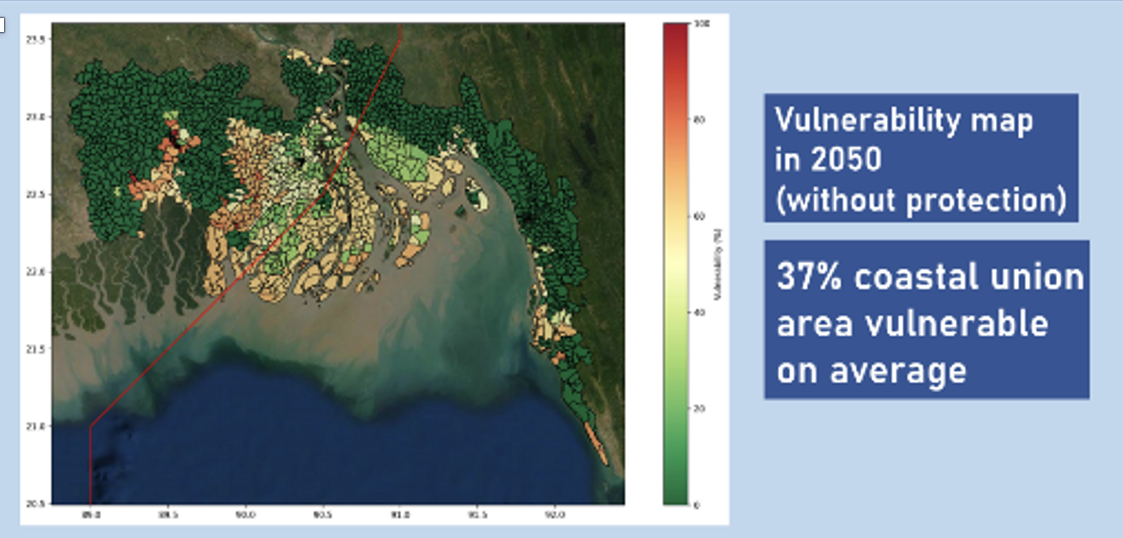
This foresight scenario examines how rising sea levels—projected to increase by 20–35 cm by 2050—could displace nearly one million people and inundate up to 2,800 km² of land in Bangladesh. The team compared two futures: one without protection and another combining nature-based solutions (NbS) such as coastal tree plantations with hard infrastructure like raised embankments. Their analysis shows that integrated measures could reduce vulnerable coastal areas from 37% to 30% and protect about 238,000 people and 60,000 homes, demonstrating how hybrid protection strategies can build long-term coastal resilience.
Compounding disasters: Floods, heatwaves, and drought (India)
Indian Institute of Technology Hyderabad, India
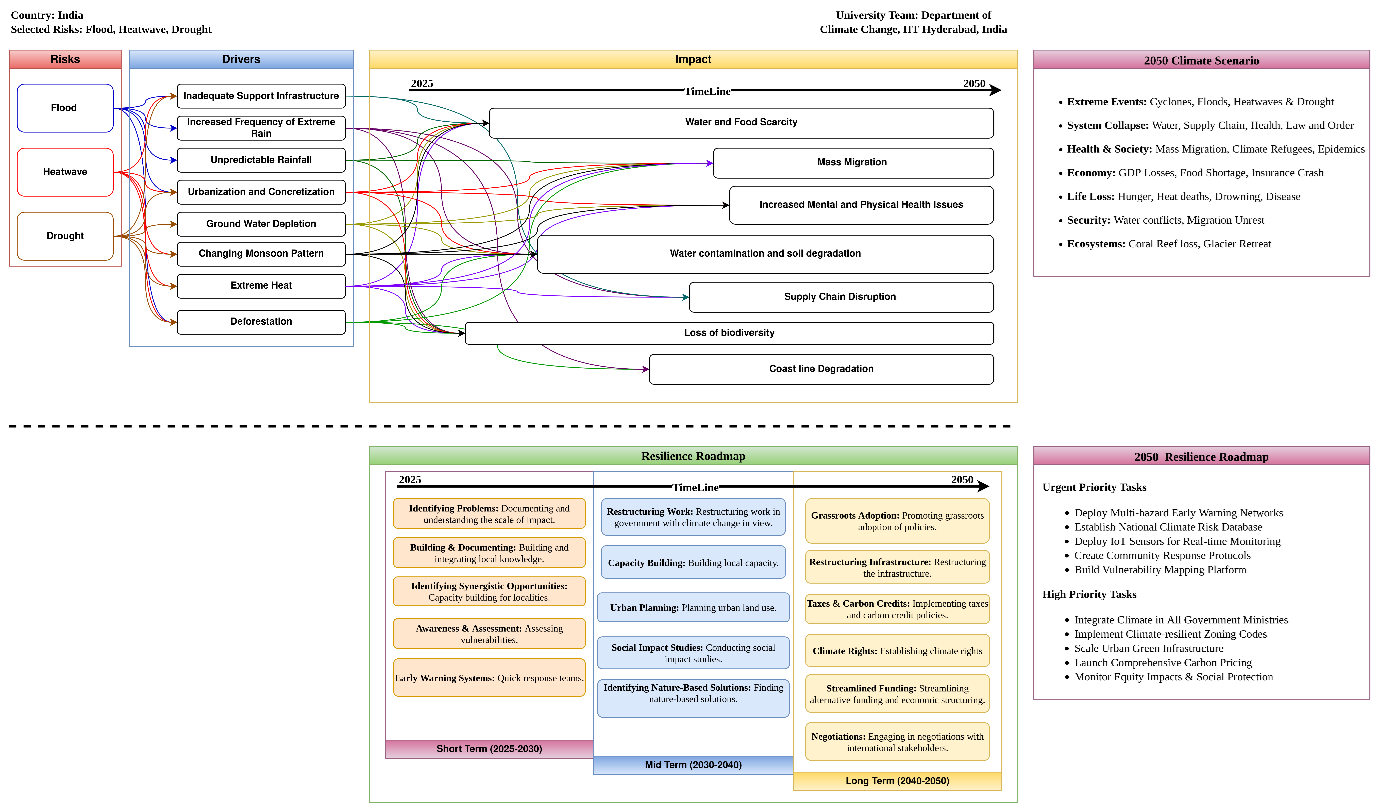
This foresight scenario proposes a comprehensive, five-pronged approach to strengthen India’s climate resilience by 2050. It integrates nature-based solutions—from mangrove restoration to sustainable agriculture—with youth-centered governance platforms that foster innovation and intergenerational equity in adaptation planning.