
Global cooperation takes center stage at the International Disaster Resilience Leaders Forum Incheon 2025
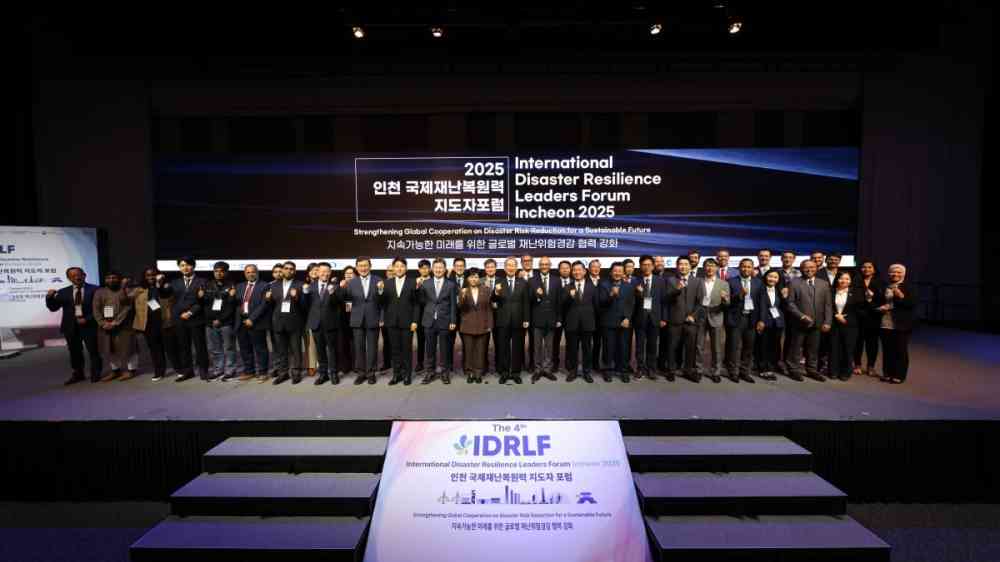
For the fourth year in a row, the International Disaster Resilience Leaders Forum (IDRLF) in Incheon, Republic of Korea brought together over 300 local leaders, national government officials, technical experts, and international organizations from across Northeast Asia and beyond to exchange knowledge and innovative practices in disaster risk reduction. Held under the theme “Strengthening Global Cooperation on Disaster Risk Reduction for a Sustainable Future” on 29-30 September, the fourth edition of the Forum underscored the urgent need for international solidarity and collective action to accelerate progress on the Sendai Framework for Disaster Risk Reduction 2015-2030 and the 2030 Agenda for Sustainable Development.
Hosted by Incheon Metropolitan City—a Resilience Hub under the Making Cities Resilient 2030 (MCR2030) initiative—and co-organized with the Incheon Institute and the United Nations Office for Disaster Risk Reduction (UNDRR) ONEA & GETI, with support from the Ministry of the Interior and Safety (MOIS) and in collaboration with the Trilateral Cooperation Secretariat, the Forum provided an inspiring platform for sharing practical solutions, policy innovations, and financing strategies to build urban resilience in the face of growing disaster and climate risks.
A Call for Global Cooperation
Opening the Forum, Mr. Byoung-pil Ha, Vice Mayor for Administrative Affairs of Incheon Metropolitan City, emphasized the importance of international collaboration, noting that “disasters are not the problem of a single city or a single country" and that "the only way to prepare for climate change and disasters is for cities around the world to share their experiences and information, and to strengthen disaster resilience through international solidarity.” His remarks were echoed by Mr. Young-Soo Choi, Director of the APEC Disaster and Safety Support Group at MOIS, who highlighted the importance of shared expertise that “in a complex environment, relying solely on the expertise of any one actor has its limits. The role of collective intelligence is equally crucial in the field of disaster management.”
“Disasters are no longer confined to a particular region or a single generation – they have become an existential challenge for human civilization as a whole. […] So, what path shall we choose now? Shall we endure isolation, relying only on our own strength? Or shall we share our experiences and wisdom with one another and open the way to sustainable cooperation?”
- Ms. Seung-bun Yoo, Vice Chair of the Public Administration and Safety Committee of the Incheon Metropolitan Council
Regional Leadership and City-to-City Cooperation
Building on the outcomes of the Global Platform for Disaster Risk Reduction 2025 (GP2025) held in Geneva, the Forum reaffirmed the need to localize DRR efforts and integrate resilience into development cooperation. In a video message, Mr. Kamal Kishore, Special Representative of the United Nations Secretary-General for Disaster Risk Reduction, stated that "the impact of disasters is always felt most intensely at the local level. […] I welcome this Forum’s theme, ‘Strengthening Global Cooperation on Disaster Risk Reduction for a Sustainable Future,’ because local authorities and communities need greater support to reach their full resilience potential.”
The Forum featured a high-level roundtable with leaders from Northeast and Southeast Asia, showcasing regional cooperation efforts and identifying opportunities to strengthen bilateral and multilateral partnerships. MCR2030 Resilience Hubs also shared examples of city-to-city collaboration, peer learning, and inclusive governance models that are helping scale up local resilience efforts.
Financing Resilience and Empowering Communities
A dedicated session on mobilizing finance for local resilience examined innovative ways to attract investment, leverage public–private partnerships, and strengthen dedicated budgets for disaster risk reduction at the local level. The Forum further highlighted the importance of community-based networks and collaborative policy research, stressing how local knowledge, trust-building, and inclusive decision-making can enhance disaster risk governance. It concluded with a lively “Voices of the Future” session, where university students from Incheon shared forward-looking ideas for global cooperation in disaster risk reduction, ranging from digital twin technologies to youth-inclusive resilience strategies.
The annual Forum is a flagship initiative of Incheon City as part of its commitments as a Resilience Hub under Making Cities Resilient 2030 (MCR2030) – a UN-led global collaboration of local governments and partners committed to urban disaster resilience.