
WRRC Webinar: Enhancing National Systems for Assessing Loss and Damage
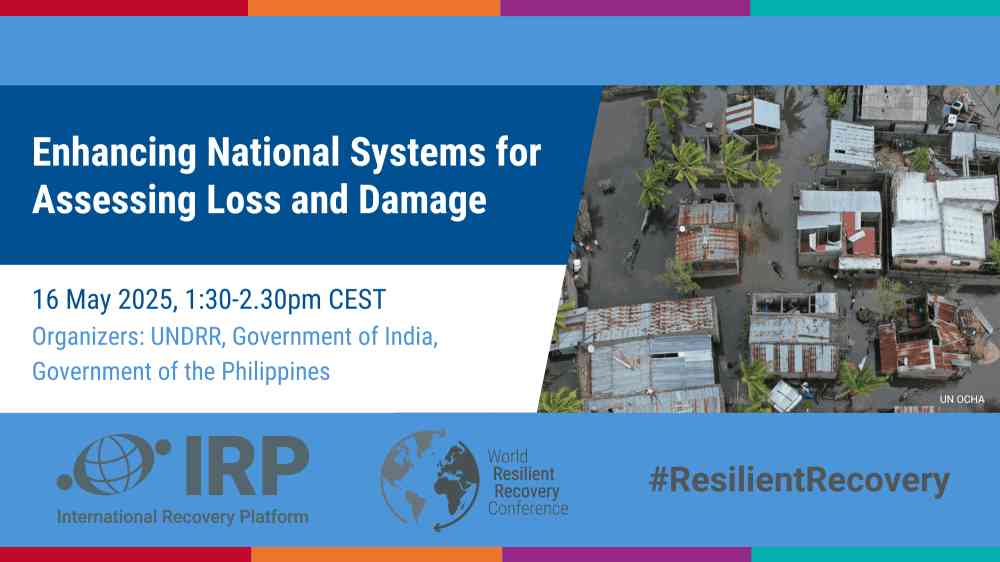
This webinar, a precursor to the World Resilient Recovery Conference (WRRC), aimed to explore the critical practical and policy challenges in post-disaster loss and damage assessments while highlighting emerging solutions that can ensure that countries are better prepared to assess, quantify, and respond to disaster-induced losses in an increasingly risk-prone world.
This webinar was jointly organized by the United Nations Office for Disaster Risk Reduction (UNDRR), the Government of India and the Gorvernment of the Philippines.
Background
In recent decades, natural hazards—including climate-induced disasters—have become increasingly frequent and severe, causing immense human and economic devastation and significantly hindering sustainable development. In 2023 alone, 399 disasters claimed over 86,000 lives, affected 93.1 million people, and caused economic losses of approximately USD 202.7 billion.
These alarming figures underscore the urgent necessity for robust, accurate, and timely loss and damage assessment mechanisms to facilitate effective recovery and secure timely financial support. The varied nature of risks faced by countries also underscores the importance of a whole-of-society, multi-hazard risk approach that bridges disaster risk reduction and climate change adaptation and accounts for non-economic losses.
However, several systemic barriers impede countries' ability to conduct comprehensive loss and damage assessments. Methodological inconsistencies and lack of international standardization frequently lead to conflicting loss estimates. Data gaps and insufficient baseline information further complicate accurate loss evaluations. Limited technical capacities and fragmented institutional coordination exacerbate delays. Additionally, significant challenges remain in quantifying non-economic losses.
At the same time, emerging technologies and innovative policy approaches present promising solutions. Advanced geospatial technologies, including satellite imagery, drones, and AI-based analytics, have rapidly enhanced assessment capabilities. The establishment of the Fund for Responding to Loss and Damage (FRLD) at COP28 provides a significant opportunity for developing countries. International initiatives such as the Santiago Network or the International Recovery Platform (IRP) are also playing a critical role in strengthening national capacities.
Session objectives
- Identify challenges in assessing loss and damage
- Share concrete experiences from recent disasters
- Showcase emerging solutions & suggest priority actions that integrate solutions and build capacity
Speakers
- Moderator and Opening Remarks: Mr. Sujit Mohanty, Chief of Branch, Intergovernmental processes, Interagency Coordination and Partnerships, UNDRR
- Krishna Vatsa, Member, National Disaster Management Authority, Government of India
- Ms. Noralene M. Uy, Assistant Secretary for Policy, Planning and Foreign-Assisted and Special Projects, Department of Environment and Natural Resources, Government of the Philippines
- Mr. Daniel Cetoupe, Chief Risk Management Officer, Ministry of Internal Affairs, Government of Seychelles
- Mr. Papazoumana Diarra, Head of Contingency Planning department, African Risk Capacity Agency
Watch the event recording