
Serbia moves to keep small businesses running when disaster strikes
Micro, small and medium-sized enterprises (MSMEs) are at the heart of Serbia's economy, accounting for 99% of all enterprises and, in 2024, more than 64% of employment and 56.9% of total gross value added. Yet they remain highly exposed to disaster risks, such as floods, fires, power outages, cyber-attacks and supply chain failures. These can disrupt operations, damage assets, cut revenues, and threaten livelihoods.
Through UNDRR’s Resilient Western Balkan initiative, financed by the Italian Agency for Development Cooperation (AICS), the Chamber of Commerce and Industry of Serbia (CCIS) is helping MSMEs to build their disaster resilience and business continuity planning capacities. The initiative is developing a tailored package of MSME resilience tools and establishing a sustainable Business Continuity Advisory Service to train advisors nationwide to support MSMEs across the country.
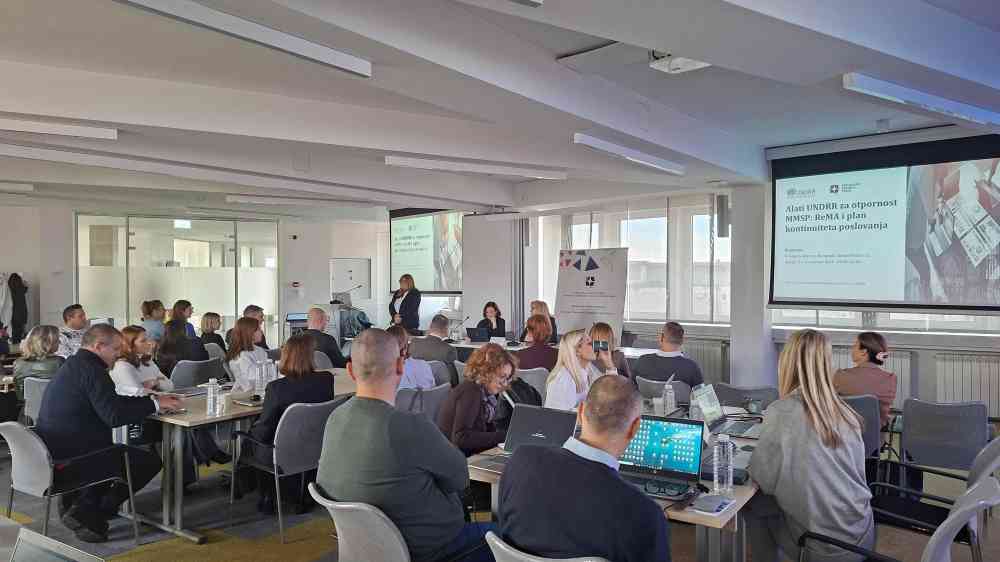
A workshop held on 17 November in Belgrade brought businesses, ministries and international partners together to learn about the tools and process. Participants used the Resilience Maturity Assessment (ReMA) tool, developed by UNDRR and the Corporate Chief Resilience Officers (CCRO) network, to self-asses their businesses’ capacities to withstand disruptions and adapt to change. They also previewed the new Serbian-language package of guidelines and templates to support business continuity planning, aligned with UNDRR’s global guidance.
“MSMEs face particular challenges: limited capacity and know-how, no systematic financial support for building resilience, dependence on critical infrastructure, and increasingly complex market and supply chain requirements, especially for climate and cyber resilience,” said Vidosava Džagić, Assistant Director of the Chamber of Commerce of Belgrade, CCIS. “With UNDRR’s support, CCIS will build advisory services across the chamber system to help micro and small enterprises in particular assess their resilience maturity and develop business continuity plans, using UNDRR guidelines and the ReMA tool, as well as good international practice. Sector guides and templates will come first for manufacturing, food production, and transport and logistics, followed by IT services. Businesses are ready to help test the tools so they fit Serbian practice, and want joint business continuity simulations to be organised with other MSMEs and the Sector for Emergency Management.”
A 2020 survey by the Chamber of Commerce and Industry of Serbia (CCIS) and UNDRR highlighted gaps in MSMEs’ capacity and resources to address disaster risks. Nearly half of surveyed businesses had no business continuity plans, around 40% reported that a recent disruption had halted operations for more than a month, and only 9% reported recovering with the support of insurance. While awareness of disaster risk has grown since then, business continuity planning and risk awareness remain uneven.
Under Serbian law, enterprises are required to prepare a Protection and Rescue Plan to protect people and property during an emergency. The plans provide businesses with practical tools to identify threats, prepare for emergencies and protect employees and property. But even when staff and premises are unharmed, a business can suffer serious disruption. Keeping operations running during and after a disruption requires additional planning.
Business Continuity Plans build on these efforts by helping companies prepare for disruptions that could affect their daily operations by helping them to es anticipate disruptions, minimize operational downtime and financial losses, and recover faster.
The workshop served as a starting point. Feedback from participants will shape the permanent CCIS advisory service for MSMEs, identify focus sectors for dedicated guidance materials, and inform a broader policy dialogue among Serbia's resilience stakeholders.
About the Resilient Western Balkans Initiative
The “Strengthening Transboundary Collaboration, Disaster Risk Reduction Capacities and Early Warning Systems in the Western Balkans” initiative aims to enhance disaster and climate resilience in Albania, North Macedonia, and Serbia. The initiative is implemented by UNDRR and financed by the Italian Agency for Development Cooperation (AICS). By strengthening risk knowledge, governance, early warning systems, and transboundary collaboration, the three-year initiative (July 2025 – July 2028) seeks to protect lives, livelihoods, and infrastructure across the region.