
UNDRR and UN-ODET launch strategic partnership on emerging technologies for disaster resilience
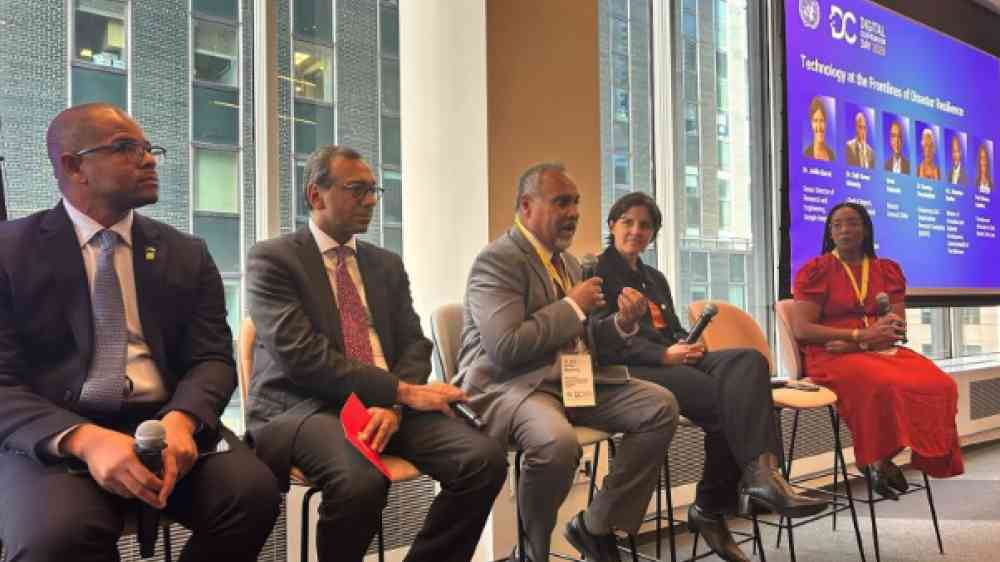
New York, 21 September 2026 – The United Nations Office for Disaster Risk Reduction (UNDRR) and the United Nations Office for Digital and Emerging Technologies (UN-ODET) launched a new strategic partnership to advance the responsible and inclusive use of digital and emerging technologies for disaster risk reduction during Digital Cooperation Day 2026, held on the sidelines of the 81st session of the United Nations General Assembly.
The session, “Technology at the Frontlines of Disaster Resilience,” brought together senior government representatives, technology leaders and experts to examine how emerging technologies can strengthen disaster risk reduction, from understanding risk and early warning to preparedness, response and recovery.
Opening the session, Esther Dweck, Minister of Management and Innovation in Public Services of Brazil, highlighted the potential of digital technologies and artificial intelligence to improve climate-risk analysis, monitoring and public-sector decision-making. Ms. Dweck also emphasized that the use of new technologies in high-impact contexts must be transparent, accountable, secure and people-centered, and called for stronger international cooperation to ensure that technological advances contribute to equitable development.
The panel brought together Sebastian Bastian, Minister of Innovation and National Development of The Bahamas; Joëlle Barral, Research & Engineering Senior Director at Google DeepMind; Vivek Badrinath, Director General of GSMA; Soumya Swaminathan, Chairperson of the M S Swaminathan Research Foundation; and Sujit Kumar Mohanty, Chief of Branch at UNDRR. The discussion was moderated by Prof. Monica Sanders, Founder and Advocate in Chief of Bonne Terre Labs.
A central message from the discussion was that technological progress will only translate into greater resilience if governments and institutions are able to absorb and use it effectively. Participants stressed the need to begin with clearly defined national and local challenges, while investing in skills, institutional capacity, governance and partnerships that allow new technologies to be integrated into existing disaster risk management systems.
Mr. Mohanty noted that while the Sendai Framework predates many of today’s digital and emerging technologies, its priorities remain highly relevant. What is changing is the way countries can implement them. He emphasized that frontline disaster managers need the institutional mandate, governance arrangements and capacity to use new technologies confidently and responsibly in operational decision-making.
From the perspective of The Bahamas, Mr. Bastian stressed that countries should first be clear about the problem they are seeking to solve before turning to technology. He highlighted the importance of building national capacity not only to use new systems, but also to assess them, negotiate with providers and adapt them over time.
Private-sector perspectives reinforced the same message. Google DeepMind highlighted advances in AI-enabled forecasting, including flood and hurricane prediction, while emphasizing that better forecasts only create value when governments and institutions can translate them into action. GSMA pointed to the potential of mobile networks and cell broadcast systems to extend warnings rapidly to populations at risk, illustrating how both advanced and relatively simple technologies can strengthen resilience when supported by appropriate governance and implementation arrangements.
Against this backdrop, UNDRR and UN-ODET presented the initial direction of their new collaboration, aimed at helping countries move from interest in emerging technologies toward their practical and responsible adoption for disaster risk reduction. The partnership will focus on strengthening knowledge and cooperation, better connecting national needs with relevant expertise and solutions, and creating opportunities to test promising approaches with Member States and partners.
Closing the session, Amandeep Singh Gill, United Nations Under-Secretary-General and Special Envoy for Digital and Emerging Technologies, welcomed the growing partnership between UNDRR and UN-ODET. He emphasized that technology alone will not be sufficient: countries also need training, skills, capacity and partnerships, particularly if the benefits of innovation are to reach those most exposed to disaster risk.
The New York session marked the public launch of the partnership and the beginning of a wider process of consultation with Member States and partners to shape its future direction.