
Tokyo workshop charts practical pathways for emerging technologies in disaster risk reduction
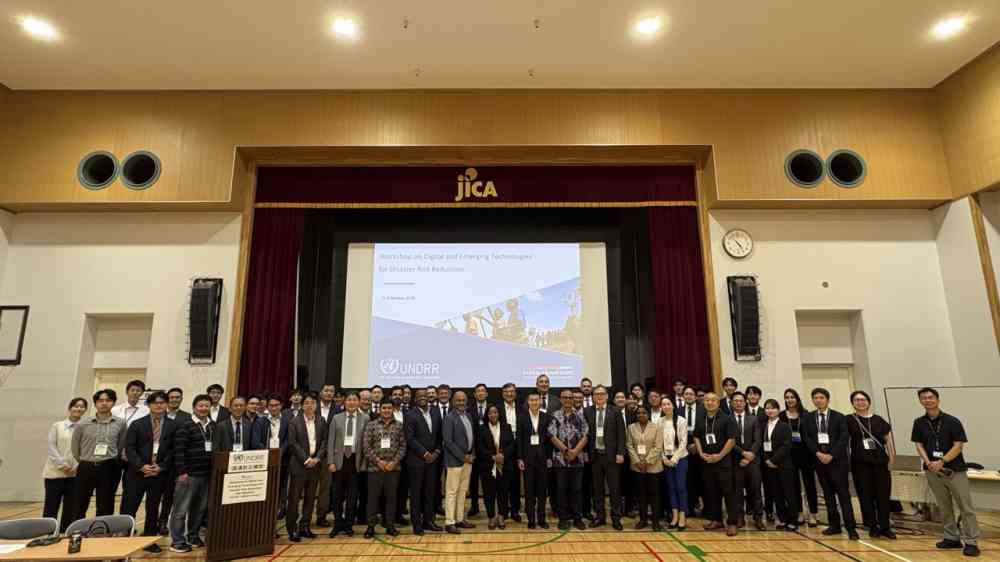
Tokyo workshop charts practical pathways for emerging technologies in disaster risk reduction
Tokyo, Japan – 2 October 2026
Governments, technology companies, researchers and international organizations came together in Tokyo from 1 to 2 October to explore how artificial intelligence and other emerging technologies can be translated into practical tools for reducing disaster risk.
The Workshop on Digital and Emerging Technologies for Disaster Risk Reduction was organized by the United Nations Office for Disaster Risk Reduction (UNDRR), with the support of the Government of Japan, the Japan International Cooperation Agency (JICA) and Sendai City, and in partnership with the United Nations Office for Digital and Emerging Technologies (ODET).
Artificial intelligence, earth observation, remote sensing, geospatial analytics, predictive modelling and digital platforms are rapidly expanding what is possible across the disaster risk management cycle. Yet discussions in Tokyo highlighted that the central challenge is increasingly not the availability of technology, but the ability of institutions to identify appropriate solutions, integrate them into existing systems and sustain their use over time.
Government representatives highlighted common challenges including fragmented and incomplete data, data reliability and security, limited technical and institutional capacity, financing constraints, interoperability with existing systems and the difficulty of moving promising technologies beyond pilot projects. Participants emphasized that technology adoption should begin with a clearly defined disaster risk reduction challenge rather than with a particular technological solution.
The workshop combined government experience with perspectives from technology companies, universities and research institutions. Discussions covered practical applications ranging from artificial intelligence and geospatial analytics to flood forecasting, digital platforms, earth observation and affordable technologies for resilience.
A central focus was the development of a proposed joint UNDRR–ODET initiative on AI and emerging technologies for disaster risk reduction. Building on consultations with governments and partners, the initiative is being developed around four interconnected areas:
- Knowledge products, documenting practical applications, good practices and lessons from countries;
- Peer exchange and cooperation, enabling disaster management authorities to learn directly from one another;
- Needs assessment and technology matchmaking, helping countries define priority needs and connect with relevant technology, research and development partners; and
- Testing and pilot environments, including sandbox approaches that allow promising technologies to be assessed in real-world settings before wider adoption.
Participants helped make these areas more concrete. Governments called for practical tools to assess their readiness for emerging technologies and suggested that countries at different levels of maturity could learn from one another’s experience, including what did not work as well as successful approaches.
The discussions also examined how technologies could be tested before being scaled. Participants stressed the importance of reliable historical data, clear operational objectives, agreements on data access and security, involvement of national and local authorities, technology providers and research institutions, and clear criteria to assess performance, compatibility with existing systems, cost and scalability.
The Tokyo workshop builds on the growing collaboration between UNDRR and ODET to bridge the disaster risk reduction and technology communities. An important part of the collaboration will be connecting disaster management practitioners with wider expertise in artificial intelligence, data and digital technologies, including through ODET's global AI capacity-building networks.
UNDRR and ODET will now use the workshop findings to further refine the joint initiative and identify initial activities and country engagement opportunities. Early priorities include developing knowledge products and practical tools, strengthening peer exchange, working with interested countries to identify technology needs and use cases, and exploring a first set of opportunities for testing and implementation.
The aim is ultimately to help close the gap between rapid technological innovation and the ability of disaster management institutions to put those innovations to effective use: ensuring that emerging technologies respond to real country needs, strengthen existing systems and contribute to more resilient communities.