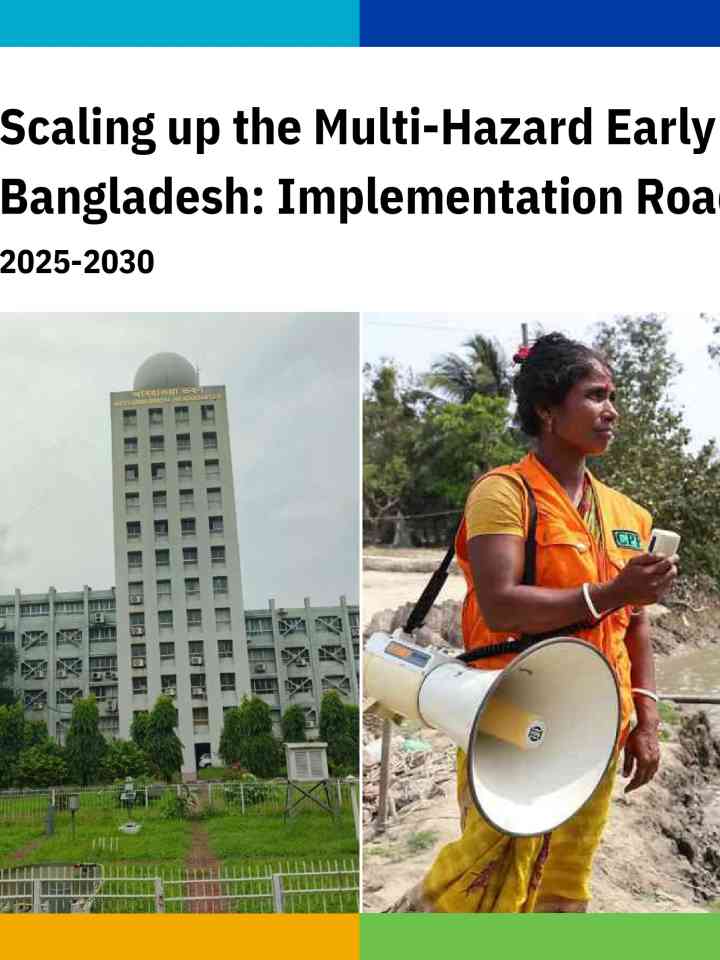
National roadmap for scaling up Multi-Hazard Early Warning Systems in Bangladesh (2025–2030)
This roadmap outlines Bangladesh’s national strategy to scale up its Multi-Hazard Early Warning System (EWS) for the period 2025–2030. Developed under the Early Warnings for All (EW4ALL) initiative, the roadmap responds to local hazard profiles, national planning cycles, and institutional capacity, drawing from gap analysis, stakeholder consultations, workshops, and surveys across relevant agencies and partners. Its structure aligns with four EWS pillars—Disaster Risk Knowledge; Detection, Monitoring, Analysis, and Forecasting; Warning Dissemination and Communication; and Preparedness and Response. The methodology prioritizes literature review, stakeholder mapping, and integration of national and global standards, involving ministries, academic institutions, UN agencies, NGOs, private sector, and community-based organizations, and is consistent with Bangladesh’s National Adaptation Plan, National Disaster Management Plan, and the Sendai Framework.
Recommendations include updating hazard profiles, improving loss and damage tracking, developing dynamic risk and vulnerability maps, establishing standardized risk assessment tools, enhancing observational infrastructure (weather stations, radar, marine buoys), expanding impact-based forecasting for multiple hazards, and scaling inclusive dissemination through reliable channels (e.g., cell broadcast technology, social media regulations, mobile charging stations). The roadmap also urges enhanced inter-ministerial coordination, capacity building, integration of indigenous and local knowledge, youth engagement, risk financing strategy, and digital platforms for risk analysis. Sustained investment, technical innovation, and targeted training—supported by dedicated funding and cross-sectoral partnerships—are seen as critical to ensure timely, actionable warnings that reach all at-risk populations.
Explore further