
How communities around the world are building resilient homes
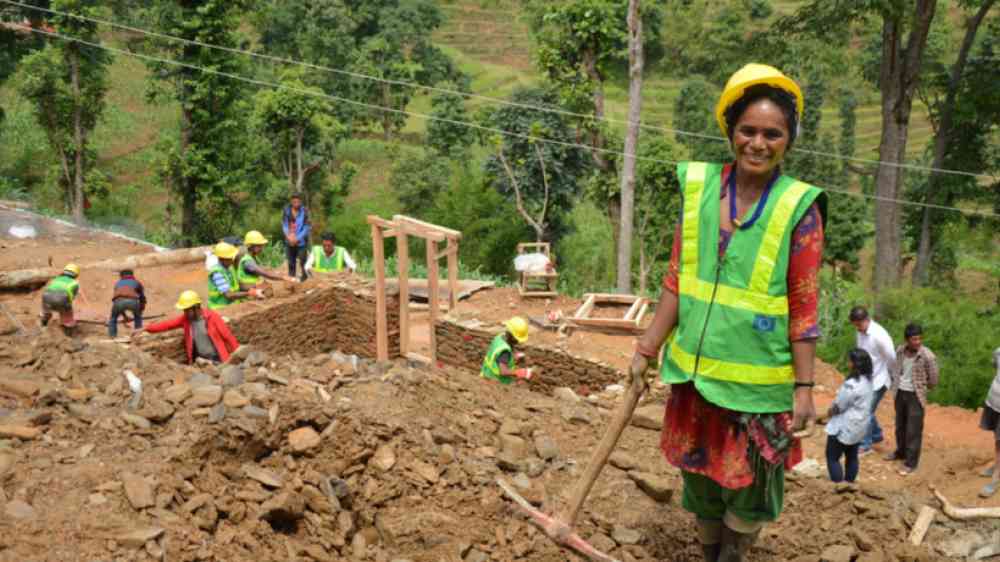
Resilience starts at home. It’s where we should feel safest, but it's also often where the impacts of a disaster are felt most deeply.
Making homes more resilient isn’t just about stronger walls or better building materials. It’s about understanding the risks people face, working with communities and finding solutions that help people live safely, before disaster strikes, not simply rebuild afterwards.
This International Day for Disaster Risk Reduction (IDDRR), we look at six examples from around the world that show what it really means to put resilience into practice, starting at home.
Colombia,Bogotá: Making vulnerability visible
In Bogotá, AI is helping the city spot vulnerable homes before disaster strikes.
Street-level images captured by vehicle-mounted cameras are combined with drone imagery to identify structural risks, including “soft-storey” buildings that can be particularly vulnerable during earthquakes. The approach was partly inspired by the devastating 2017 Mexico City earthquake, which caused more than 40 buildings to collapse and killed 26 people.
By building a clearer picture of where the risks are greatest, the city can make better decisions about where to invest in retrofitting and safer housing. As Bogotá’s Secretary of Habitat, Nadya Rangel, explains: “This technology will help the city plan housing investments in the most vulnerable areas.”
It’s a simple but important shift: making risks visible before they become disasters.
Philippines, Iloilo City: Building safety without breaking up communities
When Typhoon Fengshen devastated Iloilo City in 2008, thousands of families living in informal settlements lost their homes. But rather than simply moving people away from areas at risk, community leaders and the local government worked together to find a safer way forward.
Through the Participatory Housing Programme, the Homeless People’s Federation and city government used community surveys, savings schemes and locally managed projects to help more than 1,250 households move to safer homes. Crucially, families remained close to jobs, services and the social networks they relied on.
The result shows that reducing disaster risk doesn’t have to mean uprooting communities. As Mayor Jerry P. Treñas puts it: “I believe that having a house is a basic right.”
The approach has since helped inspire similar initiatives across Southeast Asia.
West Africa: Looking back to build for the future
Sometimes the answer to a changing climate isn’t a new technology, but an old idea.
Across West Africa, Association la Voûte Nubienne has built more than 7,000 climate-adapted homes using the Nubian Vault, a 3,000-year-old earthen construction technique. The thick earth walls and roofs keep indoor temperatures around 7°C cooler than homes with metal roofs, making them more comfortable as temperatures rise and reducing the need for energy-intensive cooling.
The organisation has also found a way to make the model more affordable. For families living on less than $2 a day, the emissions avoided through reduced cooling can generate carbon credits, helping to finance the construction of more homes.
As one homeowner in Burkina Faso describes it: “Before, I couldn’t go into my house because it was too hot. Today, the only place I want to be is in my Nubian Vault house.”
It’s a reminder that building for the future can also mean learning from the past.
Australia, Queensland: When resilience means moving
Making a home resilient doesn’t always mean rebuilding it. Sometimes, the safest option is not to rebuild at all.
After severe flooding damaged hundreds of homes in Queensland in 2022, the state introduced a Voluntary Home Buyback Programme as part of its AUD 741 million Resilient Homes Fund. Homeowners in areas facing the greatest flood risk can sell their properties at pre-flood valuations, with the land then protected from future residential development.
Alongside support for raising and retrofitting homes in areas where people can safely remain, the programme is helping communities move away from a cycle of damage, repair and rebuilding.
For residents who have lived through repeated floods, that can bring enormous relief. Paul Harding, whose home had flooded twice before, recalled: “When I heard the contract was signed I was doing cartwheels down the street.”
It’s a different way of thinking about resilience: not keeping homes standing at any cost, but helping people find somewhere safer to call home.
Colombia, Santiago de Cali: Resilience beyond the front door
In Cali, making homes safer has meant thinking about the whole community around them.
After the 2010–2011 La Niña phenomenon threatened to breach the Cauca River levee and flood the city, authorities identified 8,877 families living in informal settlements in areas where the risk could not be adequately reduced.
The resulting Jarillón Plan combines resettlement with wider investment in the places people live. A 26.1-kilometre linear park is transforming high-risk land along the levee into spaces for recreation and cultural activities, while the “Guardians of the Jarillón” initiative trains community members in emergency management, environmental conservation and urban agriculture.
Those residents now help care for and monitor the levee themselves, keeping communities closely involved in protecting the area.
Because resilience isn’t only about moving people out of harm’s way. It’s also about giving communities a role in shaping what comes next.
Austria, Vienna: Making a whole city’s homes more resilient
In Vienna, the scale of the city’s social housing system has created an opportunity to make resilience part of everyday life.
Around half of Vienna’s residents live in city-owned or subsidised housing. That means measures that might otherwise happen home by home can be introduced across entire neighbourhoods — from better insulation against extreme temperatures and rooftop solar to green roofs, permeable surfaces and water-retention areas that help manage heavy rainfall.
Alongside Vienna’s plans to phase out fossil fuels in buildings by 2040, these changes are making housing an important part of the city’s response to both climate change and disaster risk.
Rather than treating resilience as something added after a crisis, Vienna is building it into the homes and neighbourhoods people already live in.