
Building resilience at the front line of climate, disasters and food insecurity
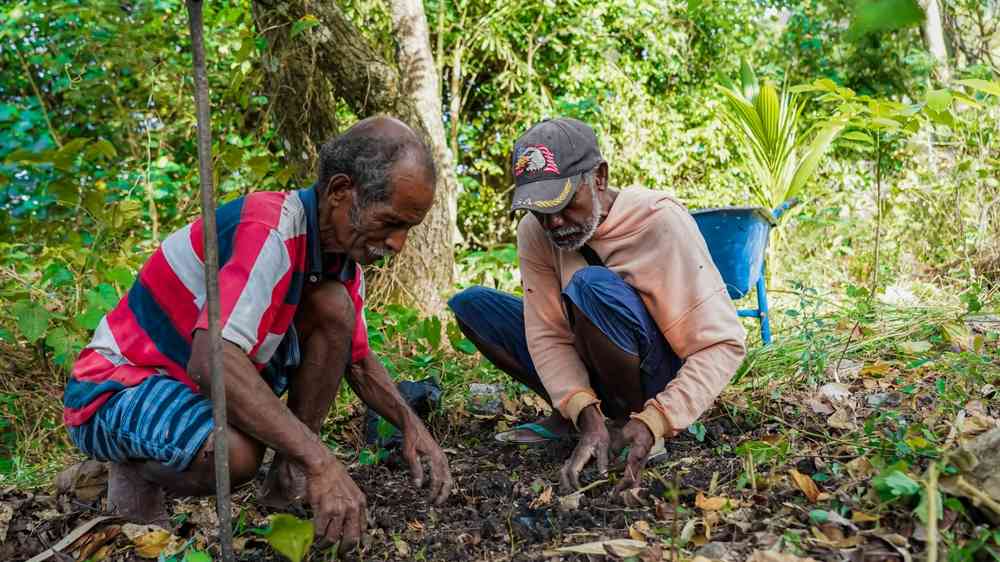
Farmers in Timor-Leste plant seeds, supporting community resilience, food security and adaptation to climate and
disaster risks.
Timor-Leste is highly exposed to climate shocks, disasters and food insecurity, with many communities facing recurring floods, droughts and landslides that undermine livelihoods, disrupt food production and deepen vulnerability. Nearly 70 per cent of the rural population is exposed to hazards, while most households depend on rain-fed agriculture, making erratic rainfall, prolonged dry seasons and sudden floods a direct threat to food security and resilience. The devastating floods of April 2021, triggered by Tropical Cyclone Seroja, highlighted the scale of these risks, causing loss of life, destruction of homes and crops, displacement, and exposing gaps in early warning systems, preparedness, infrastructure and food systems resilience.
In response, the UN in Timor-Leste is working collectively across agencies, mandates and partners to support the Government in moving from crisis response to long-term resilience. Under the leadership of the Resident Coordinator, the UNCT has adopted an integrated, risk-informed approach that recognizes the links between climate change, disasters, food insecurity, poverty, infrastructure gaps and social vulnerability. Through a multidimensional risk analysis facilitated by UNDRR, the UN and Government developed a shared understanding of how these risks intersect, informing joint programming and priorities under the new UN Sustainable Development Cooperation Framework 2026–2030. This has helped ensure that UN support is better coordinated, more targeted to vulnerable populations and focused on long-term resilience and impact.
Pooling expertise and resources from across agencies including FAO, WFP, UNICEF, UNDP, UNEP, UNDRR, UNOPS, UN Women and others, the UN is helping Timor-Leste address interconnected risks through food systems transformation, disaster risk reduction, climate adaptation, social protection, early warning and resilient infrastructure. Support is being provided through climate and development financing, including the Green Climate Fund and the Joint SDG Fund for High-Impact Initiatives on Food Systems Transformation, implemented by FAO, UNICEF, UNEP and UNDP. These efforts are helping strengthen community climate resilience infrastructure, raise awareness on loss and damage, improve weather tracking, and support early awareness and preparedness.
WFP is supporting the development of the country’s first national social registry, integrating climate risk data into poverty and vulnerability analysis so that social protection systems can respond more quickly and effectively when shocks occur. The UN’s support is also aligned with the Timor-Leste Blue Economy Strategy 2025–2035, which sets out a long-term vision for sustainable, inclusive and climate-resilient development, particularly for coastal communities and those vulnerable to climate change
The UN is also supporting a shift from disaster response to anticipation, preparedness and prevention. A major milestone is the development of Timor-Leste’s first national Disaster Risk Reduction strategy, supported by UNDRR, UN Women and the Resident Coordinator’s Office. The strategy places inclusion at its core, ensuring that women, persons with disabilities and rural communities are part of decision-making and solutions. At community level, new multi-hazard early warning systems are being established through a joint effort led by UNEP, with FAO and UNOPS, combining climate data, community outreach and accessible communication tools, such as solar-powered megaphones, to reach remote areas. Simulation exercises and community engagement activities help ensure that warnings translate into early action.
Through a GCF-supported programme implemented by UNDP, the UN is helping climate-proof critical infrastructure such as roads, bridges, irrigation systems and water supply networks, while also rehabilitating degraded land and catchments to reduce flood risk and improve agricultural productivity. Innovative tools, including drones and mobile applications, are being introduced to improve disaster assessment and planning. UNICEF is also supporting climate-resilient WASH systems to help ensure that children and communities maintain access to safe water during droughts and floods.
Communities are central to this approach. Rural farmers, young people, women, children, older persons and persons with disabilities are not only beneficiaries of resilience-building efforts, but active participants in shaping solutions. Awareness-raising activities, including creative approaches such as tsunami awareness songs, are helping strengthen disaster preparedness and community engagement.
By working as one, the UN is helping Timor-Leste align climate action, disaster risk reduction and food security, strengthen national systems and institutions, and support communities to anticipate, withstand and recover from shocks. In Timor-Leste, resilience is no longer being built sector by sector, but collectively, through coordinated action, strong partnerships and locally driven solutions. As the President of the Civil Protection Authority, Mr Jesuino dos Reis Matos de Carvalho, noted:
“Through coordinated action and strong partnerships, the UN is helping the country move from vulnerability to resilience, ensuring that when the next crisis comes, communities are better prepared, better protected, and better able to thrive.”