
Advancing urban disaster resilience through global collaboration and South-South and Triangular Cooperation
The United Nations Office for Disaster Risk Reduction (UNDRR) through its Global Education and Training Institute (GETI), in collaboration with the United Nations Office for South-South Cooperation (UNOSSC), the Pan American Health Organization (PAHO), and the United Nations Technology Bank for the Least Developed Countries (UNTB), successfully delivered the Joint Certificate Training Programme on 29 April and 6, 13 and 20 May 2026, marking the sixth year of this strategic capacity development collaboration.
The training titled ‘Leveraging Technological Innovation, Evidence-Based Decision-Making and South-South Cooperation to Address Systemic Urban Risk and Strengthen Disaster Resilience’ addressed the growing complexity of urban risk, including climate-related hazards, extreme heat, health emergencies, and cascading impacts across interconnected systems. It explored how cities and national governments can strengthen disaster risk management through the use of practical tools, technological innovations, and evidence-based decision-making. The programme also emphasized the importance of knowledge sharing and collaboration across countries, with particular attention to the needs of developing countries and Least Developed Countries.
“This programme has become a model for South-South and triangular cooperation on disaster risk reduction and public health preparedness… It reinforces the importance of South-South and triangular cooperation as a powerful mechanism for sharing good practices, strengthening institutional capacities, and scaling up successful solutions.”
- Kamal Kishore, Special Representative of the UN Secretary-General for Disaster Risk Reduction and Head of UNDRR
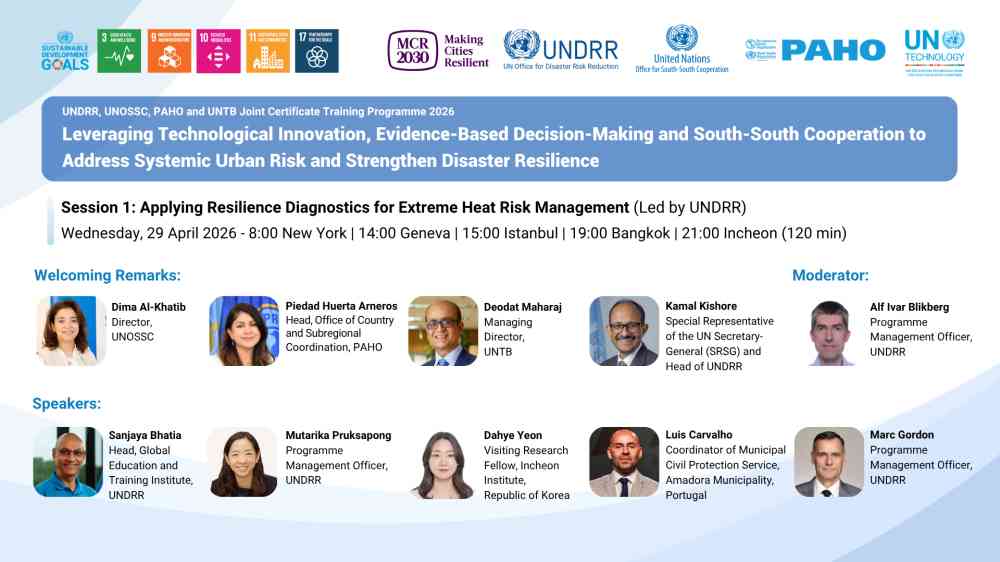
The first training session was led by UNDRR, with the focus on applying resilience diagnostics for extreme heat risk management. The session introduced the links between urbanization, climate change, and increasing exposure to extreme heat. It examined how extreme heat affects public health and puts pressure on urban infrastructure and essential services. It also showed how these impacts can compound existing vulnerabilities. Participants were introduced to practical resources, including the MCR2030 Urban Heat Risk Resource Package and the Disaster Resilience Scorecard for Cities – Addendum on Extreme Heat Risk Management, which support structured diagnostics and evidence-based local planning. The session also presented the Extreme Heat Risk Governance Framework and Toolkit, which support coordination across sectors and levels of government and help integrate extreme heat risk into broader resilience strategies.
City level experiences from Incheon Metropolitan City (Republic of Korea) and Amadora Municipality (Portugal) demonstrated the application of technological innovation, data-driven decision-making, and strengthened urban heat risk reduction measures. These examples illustrated how practical tools and approaches are applied in practice, guiding both immediate heat response actions and longer-term integration of heat risks into urban development and planning processes.
“This course really brought home how we can't treat extreme heat and climate risks as isolated issues, they require tech-driven, connected strategies to protect urban health. I plan to put this into practice by using geospatial tools and resilience scorecards to turn complex climate data into clear, actionable visual insights for decision-makers.”
- Hajra Qadeer, Assistant Manager, National Disaster Management Authority (NDMA), Pakistan
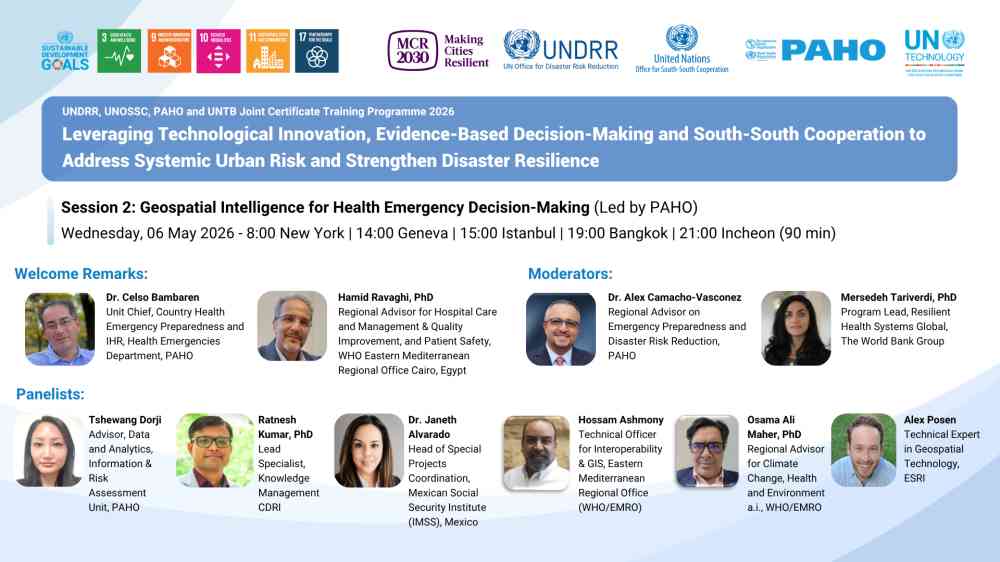
The subsequent sessions expanded on related areas of urban risk and resilience. The second session, led by PAHO, examned how geospatial intelligence can support decision making in health emergencies. It introduced the use of spatial data, geographic information systems, and analytics in health emergency contexts. These tools help identify at-risk populations and support response planning in complex urban environments.
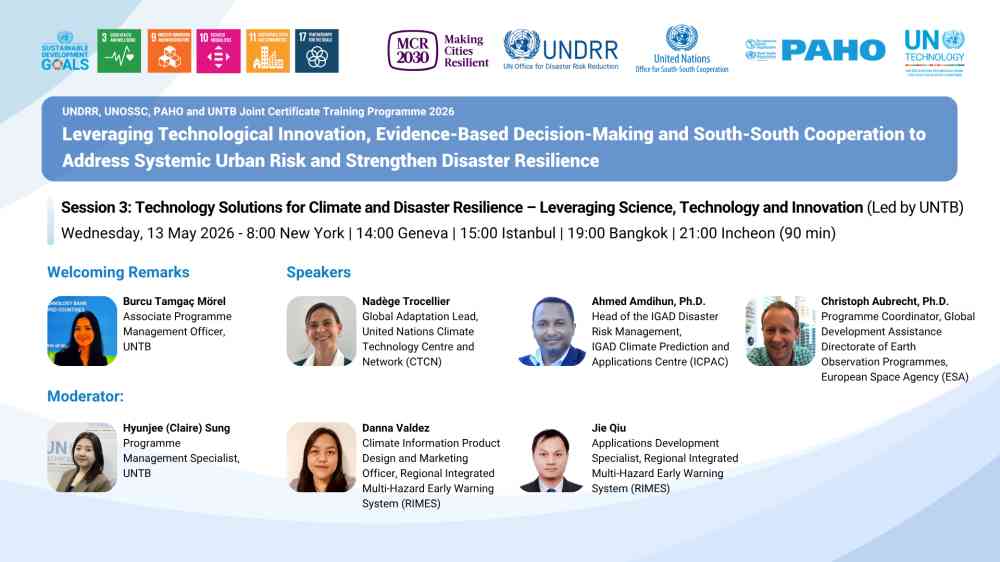
The third session, led by UNTB, focused on science, technology, and innovation for climate and disaster resilience. Participants reviewed practical and scalable technological solutions, including systems for risk monitoring and early warning. The session also addressed challenges related to access to technology and data, particularly in developing countries and Least Developed Countries.
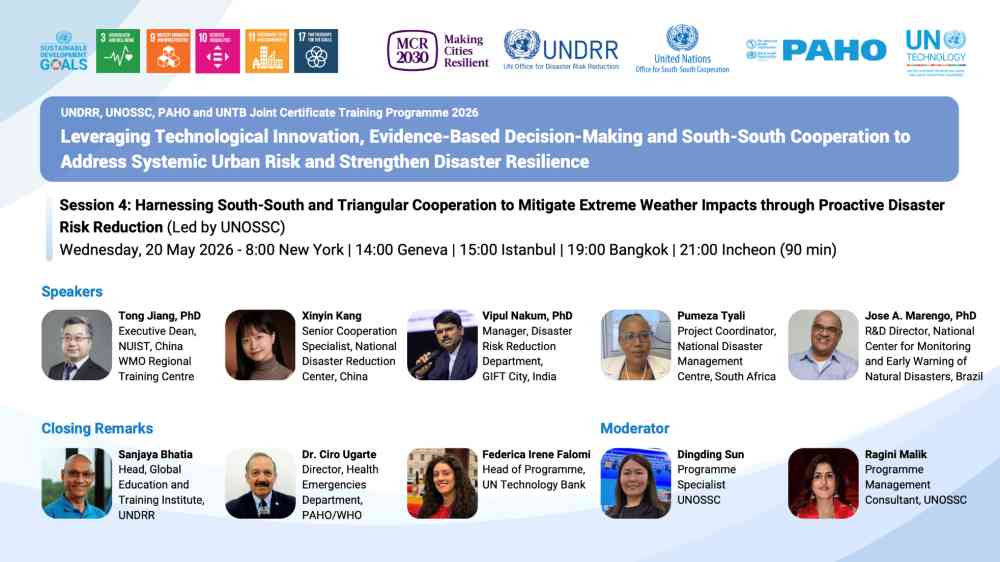
The final session, led by UNOSSC, highlighted how countries can exchange knowledge and practical solutions through South-South and Triangular Cooperation. Case examples demonstrated how collaboration supports the adaptation and scaling of approaches across different contexts. The session also emphasized the role of partnerships in strengthening long term resilience and preparedness efforts.
"One key realization from the lecture is that disaster resilience is not just about reacting to crises, but about using innovation, reliable data, and shared learning between countries to prepare cities before disasters happen. I plan to use these ideas in San Juan City by advocating for smarter disaster preparedness—using technology, accurate local data, and lessons from other cities to improve early warning, emergency response, and community resilience. This will help the city shift from reactive disaster response to proactive risk reduction."
- Abigayle Baligod, City Director of the Department of the Interior and Local Government, San Juan City, the Philippines
The UNDRR-UNOSSC-PAHO-UNTB Joint Certificate Training Program 2026 brought together 36 expert speakers and was delivered with simultaneous interpretation in Arabic, Chinese, French, Portuguese, Russian, and Spanish, alongside International Sign Language to support accessibility and inclusion. Since its launch in 2020, the training series has grown into a global platform for knowledge exchange and capacity development. The 2026 edition reached a total of 3,053 participants from over 1,050 cities across 169 countries and territories, including 42% women, 39% youth, and 5% persons with disabilities, reflecting its continued global reach and relevance.