
UNDRR
Strategic Framework
2026-2030
Accelerated action for a safer, more resilient future
UNDRR’s Strategic Framework (2026-2030) sets out our strategic direction and key actions to help accelerate implementation of the Sendai Framework in its final five years.
At the core of this framework are four interconnected and mutually reinforcing catalytic areas that sharpen our focus to address the key gaps and recommendations identified by the midterm review of the implementation of the Sendai Framework:
- risk knowledge;
- locally-led disaster risk reduction;
- financing for disaster risk reduction; and
- recovery readiness.
UNDRR's mission and value proposition
Our mission
We lead and accelerate global efforts to reduce disaster risk by helping communities, governments and businesses safeguard people, assets and progress in the face of growing shocks and uncertainty. We are committed to realizing the ambitions of the Sendai Framework and leaving no one behind.
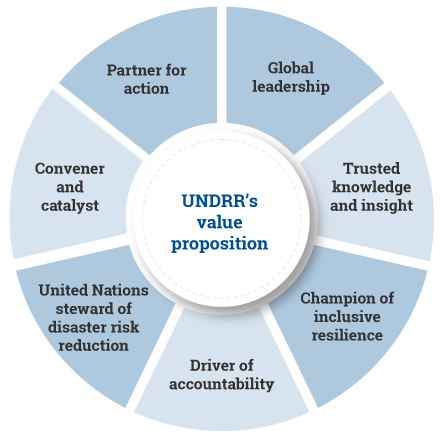
Our value proposition
We lead global efforts to reduce disaster risk by protecting lives, safeguarding development gains and accelerating resilience in a rapidly changing world. We develop risk knowledge and translate it into action. Through trusted leadership and meaningful collaborations, we help communities, governments and businesses anticipate, prevent and reduce the impacts of disasters.
Underlying principles
The underlying principles are foundational for all aspects of our work. Embedded in our organizational DNA, they reflect our shared values, serving as guiding considerations in all our actions and decisions and shaping how we deliver our mandate.
Leave no one behind
We prioritize the needs, participation and leadership of those most at risk– including people living in poverty, women, children and youth, older people, persons with disabilities, Indigenous Peoples, displaced people and other marginalized groups – to ensure disaster resilience is inclusive, equitable and effective for all.
Risk-informed development
We work to embed disaster risk considerations across sectors and systems, investment decisions and all relevant policy areas from global frameworks to local planning so that growth is disaster-resilient and sustainable over the long term.
A multi-hazard approach and policy coherence
We help partners understand and take action to address the full spectrum of hazards, ensuring that strategies are comprehensive, forward-looking and adaptive.
Catalytic areas of focus
The four catalytic areas of focus are firmly anchored in our core mandate. They leverage new and innovative approaches and take into account our areas of comparative advantage and our capacity to deliver added value.
Risk knowledge
We aim to play a leading global role in disaster risk knowledge by fostering an open, interoperable and AI-enabled risk information ecosystem. This ecosystem will generate, share and institutionalize actionable insights for legislation, regulation, integrated policymaking, planning, budgeting, investment and anticipatory action — especially in vulnerable and fragile contexts.
Locally-led disaster risk reduction
We aim to secure the systematic institutionalization and resourcing of local risk governance as a core pillar of resilience through strengthened national policies, joint United Nations efforts, strategic partnerships, multi-stakeholder engagement, enhanced financing mechanisms and accessible capacity development. We will support subnational actors, including civil society organizations, to drive effective, inclusive and sustained local disaster resilience.
Financing for disaster risk reduction
We aim to embed DRR at the core of public financial management and investment decision-making across both the public and private sectors, driving a global shift from reactive and more costly post disaster spending to forward-looking, cost-effective, risk-sensitive investment. We seek to mobilize greater investment in DRR to ensure sufficient, predictable and sustained financing for DRR in order to secure higher standards of resilience across all investments and to enhance related reporting and tracking of progress.
Recovery readiness
We aim to make resilient recovery the global norm by strengthening recovery readiness. We will drive this shift at the international, regional, national and local levels, transforming how the world approaches post-disaster recovery and enabling relevant stakeholders to deliver more effective, efficient and timely post-disaster support.
Cross-cutting issues
Three key cross-cutting issues and approaches intersect with multiple areas of work. We will integrate them across the catalytic areas of focus to link our efforts in a more coordinated and coherent manner, achieving greater collective impact.

- Addressing gaps in risk governance
Addressing gaps in risk governance
We will continue to address remaining gaps, unintended obstacles and areas for improvement in regional, national and subnational risk governance, including in disaster risk management legislation, regulations, strategies, regional and subregional cooperation mechanisms and national platforms (or their equivalent). As part of these efforts, we will advocate for greater participation and leadership of women and persons with disabilities in DRR decision-making at all levels.
- Synergies with climate action
Synergies with climate action
We will continue and enhance this work by ensuring comprehensive disaster and climate risk management is integrated across the catalytic areas of focus. Building on these results, synergies with climate action as a cross-cutting issue will ensure climate action is embedded across our work and the integration of the two agendas into wider joint risk-informed sustainable development efforts. In doing so, we will seek to secure more-effective and more-efficient use of time, effort and resources and to deliver inclusive DRR and climate action.
- Harnessing technology and innovation
Harnessing technology and innovation
We will facilitate partnerships between governments, the private sector and other actors to close gaps in access, policy integration and institutional readiness for technological advances and innovation. We will also develop knowledge products and seek to better understand current capabilities and identify needs. Through knowledge-sharing, co-development of solutions, and targeted capacity development, we will help ensure that innovation is accessible to all, scalable, aligned with national DRR priorities and utilized to reduce, rather than increase, inequalities.
Implementing our mandate
As the designated United Nations focal point for DRR, we support Member States to strengthen their disaster resilience. Working with national, subnational and local government and regional organizations and in collaboration with strategic partners, we build risk understanding, foster risk-informed development policies and practice, legislation and governance structures, facilitate dialogue and knowledge exchange and promote good practice.
Including through our Stakeholder Engagement Mechanism, we engage with diverse stakeholders from civil society, parliamentarians, the private sector, international finance institutions, the academic and science community, the media and youth groups, among others. We bring together stakeholders to leverage their enabling and influencing power and reach to enhance risk-informed development and humanitarian action, to draw on their risk understanding, knowledge, expertise and good practice to advocate, act and lead enhanced DRR efforts from the global to local level.
We deliver our mandate together with strategic partners, leveraging our core functions:
- Coordination with the United Nations system
- Intergovernmental processes
- Convening
- Capacity development
- Guidance and technical assistance
- Advocacy, communications and knowledge management
Download the PDFs
At the core of the UNDRR Strategic Framework (2026-2030) are four interconnected and mutually reinforcing catalytic areas – risk knowledge, locally-led disaster risk reduction, financing for disaster risk reduction and recovery readiness – that sharpen our focus to address key gaps and recommendations identified by the midterm review of the implementation of the Sendai Framework.
The results framework is the backbone of the UNDRR Strategic Framework (2026-2030), turning ambition into accountability. Its four strategic objectives mirror the four priorities of the Sendai Framework, focusing on improved risk understanding, strengthened risk governance, increased investment in DRR and enhanced disaster preparedness. These objectives are supported by a set of results that translate the Strategic Framework into concrete, measurable outcomes.