
United Nations Senior Leaders call for stronger joint action to reduce disaster risk and protect development gains
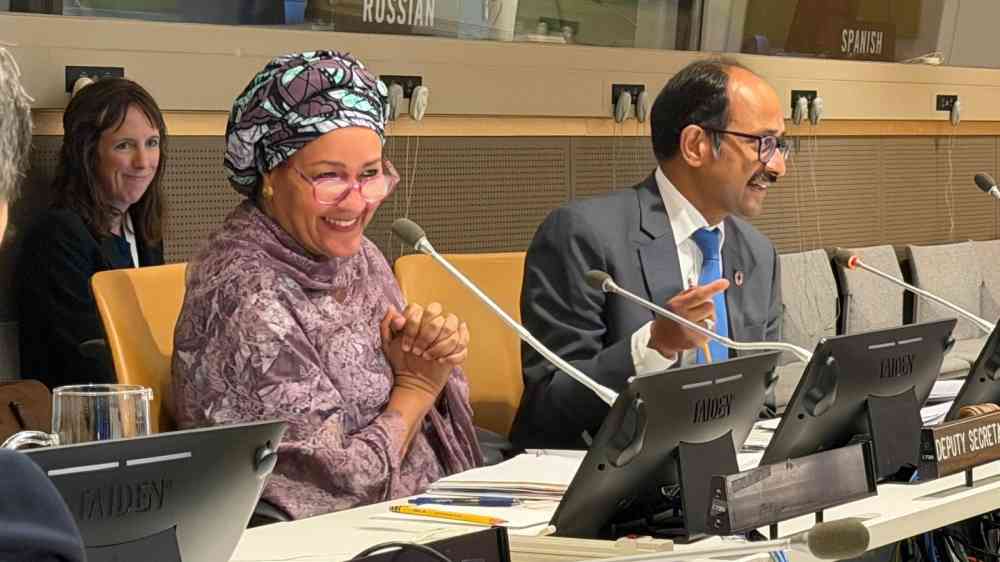
United Nations Deputy Secretary-General Amina J. Mohammed joins Kamal Kishore, Special Representative of the Secretary-General for Disaster Risk Reduction and Head of UNDRR, at the 11th meeting of the UN Senior Leadership Group on Disaster Risk Reduction for Resilience.
New York, 14 July 2026 – Thirty-six UN entities participated in New York and online in the 11th meeting of the United Nations Senior Leadership Group on Disaster Risk Reduction for Resilience (UN SLG). The meeting, chaired by Mr. Kamal Kishore, Special Representative of the Secretary-General for Disaster Risk Reduction and Head of UNDRR, focused on how the UN system can strengthen coordinated support to countries and communities amid rising disaster risks, shrinking resources and ongoing UN reforms.
Mr. Kishore opened the meeting by noting that, more than 11 years after the adoption of the Sendai Framework for Disaster Risk Reduction, progress remains uneven. While disaster mortality has declined and more than 130 countries now have national or subnational disaster risk reduction strategies, the world remains off track on reducing the number of people affected by disasters, economic losses and infrastructure disruptions.
“The UN system is doing more on disaster risk reduction than ever before, but we need to do more at the country level in terms of bringing about coherence across the work of the entire UN system.”
— Kamal Kishore, SRSG for Disaster Risk Reduction and Head of UNDRR
Discussions focused on the three guiding questions for the interactive dialogue: how to pool capacities and integrate disaster risk reduction across agendas and funding streams in a time of shrinking dedicated resources; how to ensure sustained, scalable and inclusive impact at country and local levels, particularly in least developed countries, small island developing States and fragile contexts; and how to leverage partnerships with the private sector and development banks to unlock financing and prevent further risk creation.
Across the interventions, UN entities highlighted UN80 as an opportunity to strengthen the UN system’s joint offer on disaster risk reduction, including through expertise-on-demand, the regional reset and the country configuration process. Speakers emphasized that these reforms could help reduce fragmentation, improve access to specialized risk expertise, and better connect global, regional and country-level capacities in support of national priorities.
Mr. Jorge Moreira da Silva, Executive Director of UNOPS, highlighted the convergence of armed conflict, climate and natural hazards, and financing constraints, particularly in fragile contexts. He pointed to emerging good practices from UNDRR–UNOPS collaboration, including work in Costa Rica on resilient infrastructure and emergency response, as well as examples from Afghanistan and Kiribati. He also underscored that the country team reconfiguration process provides an important opportunity to make disaster risk reduction a practical test case for more coherent, demand-driven UN support.
“Disaster risk reduction is one of the most effective ways to bring the humanitarian, development and peace agendas together.”
— Jorge Moreira da Silva, Executive Director of UNOPS
Resident Coordinators brought perspectives from the field on how risk-informed planning and financing can remain a priority despite constrained resources. Ms. Pauline Tamesis, UN Resident Coordinator in Viet Nam, highlighted how repeated typhoons and floods have reinforced the need to treat resilience as central to sustainable development and economic growth. She described Viet Nam’s efforts to embed disaster preparedness and resilience in its new UN Cooperation Framework, strengthen anticipatory action, harmonize early warning frameworks and integrate risk reduction into public investment and financing.
“We cannot treat disaster risk reduction as a standalone portfolio. It must be the foundation on which sustainable development rests.”
— Pauline Tamesis, UN Resident Coordinator in Viet Nam
From Barbados and the Eastern Caribbean, UN Resident Coordinator Simon Springett highlighted the particular challenges facing small island developing States, where fiscal constraints, limited administrative capacity and escalating climate risks make pooled expertise, anticipatory action and regional mechanisms essential.
“Regional mechanisms can overcome scale constraints, create common standards and ensure countries are not left to manage increasingly complex risks alone.”
— Simon Springett, UN Resident Coordinator, Barbados and Eastern Caribbean
Mr. Roberto Valent, DCO Regional Director for Latin America and the Caribbean, emphasized the importance of regional platforms in helping UN Country Teams access shared expertise, data and tools. He highlighted regional collaborative platforms, joint programmes and foresight tools as practical ways to sustain prevention capacity when country-level resources are under pressure.
“The regional level is essential for maintaining capacity when ground efforts weaken. Combining resources is not only more effective, it is much more cost-efficient.”
— Roberto Valent, DCO Regional Director for Latin America and the Caribbean
Interventions from UN entities reinforced the need to protect disaster risk reduction capacities despite funding cuts; strengthen risk-informed planning and financing; scale up early warning and anticipatory action; and deepen support to least developed countries, small island developing States and fragile contexts. Members also emphasized that inclusive disaster risk reduction must remain central, including through gender equality, human rights, disability inclusion, local leadership and community-level action, even as normative and cross-cutting agendas face diminishing resources.
On financing, speakers called for stronger engagement with development banks, public development banks, insurers and the private sector, while recognizing that public finance and national budget systems remain central to prevention. UNCDF highlighted blended finance, first-loss guarantees and parametric insurance as tools to de-risk investment in vulnerable countries, while IOM proposed a structured dialogue with multilateral development banks on preparedness, resilience-building and durable solutions for disaster displacement. UNCTAD emphasized the need to expand fiscal space, strengthen public finance and improve the international financial architecture so countries can invest in resilience before disasters strike.
In closing remarks, UN Deputy Secretary-General Ms. Amina J. Mohammed encouraged the UN system to use UN80 as an opportunity to reduce duplication, better deploy expertise and strengthen support to national priorities, with disaster risk reduction as an example of a cross-cutting issue that requires system-wide collaboration. She emphasized the importance of regional capacities, Resident Coordinators and country teams in bringing expertise together, and called for stronger engagement with civil society and other last-mile stakeholders who are often on the front lines of disasters.
“We need to rebuild better [after disasters] – and we need the whole of the UN system there to be able to do that.”
— Amina J. Mohammed, Deputy Secretary-General of the United Nations
The meeting concluded with the adoption of updated UN Plan of Action on Disaster Risk Reduction for Resilience 2030 targets and 2026–2027 priority actions to guide joint UN work at country level. The agreed priorities include strengthening risk governance and Cooperation Frameworks; advancing inclusive disaster risk reduction, including implementation of the Sendai Gender Action Plan; scaling up multi-hazard early warning and anticipatory action; supporting resilient recovery, housing and urban resilience; improving risk data and analysis; and expanding financing for prevention and resilience.
The UN SLG reaffirmed its role as a forum to align system-wide action and strengthen mutual reinforcement across the UN system. The outcomes will guide joint efforts to protect development gains, accelerate progress towards the Sustainable Development Goals and support communities most at risk.