
UNDRR brings disaster data to the new UN System Data Commons

On 17 September 2026 the United Nations Secretary-General António Guterres launched the UN System Data Commons, a single point of entry for finding, accessing and analyzing official UN system statistics across multiple organizations and domains.
Developed as part of the UN80 Initiative, the Data Commons allows users to search trusted UN data using common, everyday language. At launch, the platform brought together nearly 44 million data points from 26 UN system entities, including the United Nations Office for Disaster Risk Reduction (UNDRR).
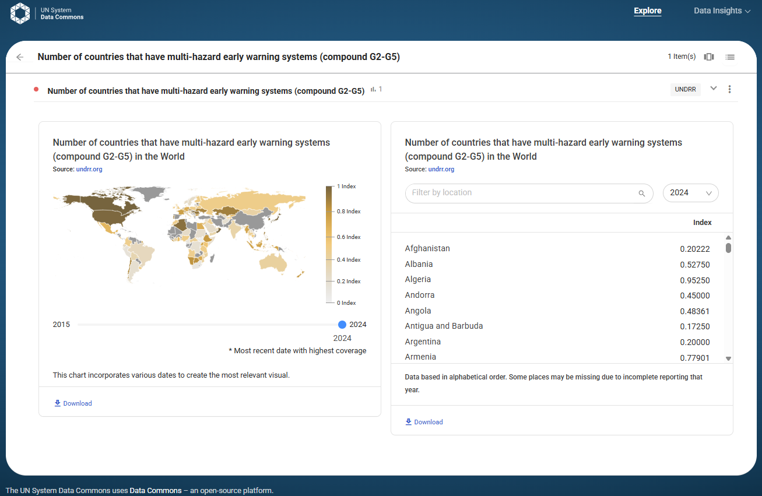
Launching the Data Commons, Mr. Guterres said, “The challenges before us are deeply interconnected. Drought undermines food security. Rising food prices deepen poverty. Poverty pushes children out of school. We cannot solve these challenges in silos.” He further added, “Access to the knowledge of the United Nations system should never depend on knowing how to navigate its organigramme. The UN System Data Commons helps remove these barriers.”
For UNDRR, participation in the Data Commons helps bring authoritative disaster risk information into a wider UN data ecosystem, making official data on disaster impacts and risk reduction more accessible and connected to other domains, such as climate change and poverty eradication.
Welcoming the launch, Mr. Kamal Kishore, Special Representative of the Secretary-General for Disaster Risk Reduction and Head of UNDRR said, “Disaster risk does not exist in isolation. It is shaped by human decisions, including in the realms of development and investment. By including official disaster statistics in the UN System Data Commons, we hope more countries and organisations will use this data to make better decisions that increase resilience and reduce disaster risks.”
Bringing Sendai Framework Monitor data closer to the global data system
At the centre of UNDRR's contribution is the Sendai Framework Monitor, the official global system through which UN Member States report progress in implementing the Sendai Framework for Disaster Risk Reduction 2015–2030.
By April 2026, 176 countries had reported data through the Sendai Framework Monitor, which also supports progress tracking of global frameworks such as the Sustainable Development Goals, the Antigua and Barbuda Agenda for SIDS, and informs the implementation of the Global Goal on Adaptation through its Belem Adaptation Indicators.
The UN Data Commons was developed specifically to address the fragmentation that has historically made cross-sectoral analysis difficult. The new platform integrates authoritative data from across the UN System into a public repository with a user-friendly interface, with a goal of including 80% of UN system statistical datasets by 2027.
For disaster risk reduction, this is especially significant, since risk cannot be understood from a single dataset or institution. This was further bolstered by last year’s launch of DELTA Resilience, the Disaster and Hazardous Events, Losses and Damages Tracking and Analysis system, which aims to enhance national and local capacities to collect and manage disaster data, while directly contributing to selected Sendai Framework targets and indicators.
A common statistical language for disaster risk
Connecting data is only one part of interoperability. To combine statistics meaningfully, users also need coherent concepts, definitions, classifications and measurement approaches.
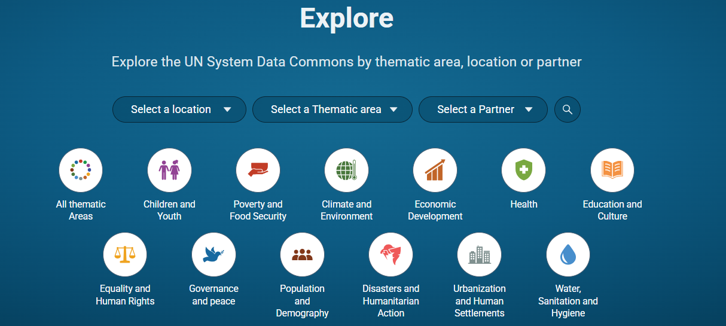
This is where the Global Disaster-Related Statistics Framework (G-DRSF) complements the Data Commons. Endorsed by the United Nations Statistical Commission at its 57th session in March 2026, the G-DRSF is the first comprehensive global statistical framework for strengthening how disaster-related statistics are defined, compiled and used within national statistical systems.
For producers of disaster-related statistics, the G-DRSF and UN Data Commons create an opportunity to make disaster data easier to produce, find and connect, by strengthening national statistical systems using internationally agreed concepts and metadata. For users, it can improve comparability and reduce the risk of misinterpreting indicators that may appear similar but measure different phenomena.
From reporting to reusable knowledge
The Sendai Framework Monitor provides authoritative country-reported data on progress in progress in Sendai Framework and the reduction disaster risk.
The G-DRSF provides the common statistical language and recommendations needed to strengthen the production and interoperability of disaster-related statistics across national statistical systems.
And the UN System Data Commons provides shared digital infrastructure through which those statistics can increasingly be discovered and connected with other authoritative information — by both people and machines.
Together, the UN System Data Commons, the Sendai Framework Monitor and the G-DRSF point towards an important evolution in disaster-risk information: from data collected primarily for monitoring and reporting towards authoritative information that can also contribute to a connected global knowledge system.