
Towards knowledge, action and resolve to address non-economic losses in the Pacific Indigenous Communities Nadi, Fiji
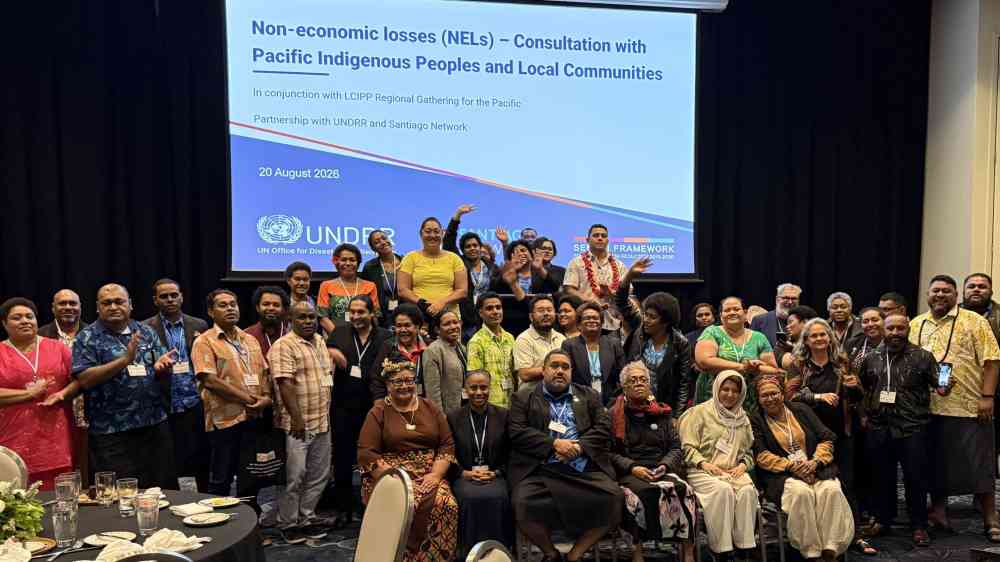
“Know your history and know what you have lost.” This was a poignant quote from Mr. Joeli Ditoka, Deputy Secretary, Policy, Ministry of ITaukei Affairs, Culture and Heritage, during the consultation on non-economic losses on 20 August 2026 in Nadi, Fiji.
It was hosted by the United Nations Office for Disaster Risk Reduction (UNDRR) in partnership with the Santiago Network Secretariat and held on the margins of the Pacific Regional Gathering of the Local Communities and Indigenous Peoples Platform (LCIPP), from 18-21 August 2026.
The consultation reaffirmed evidence of the growing impact and risk from climate change, and deep concerns that Indigenous Peoples have for their present and future. About 45 participants, primarily from Indigenous Peoples across 11 countries, were present, sharing their understanding and experience with the non-economic losses affecting their communities.
Participants acknowledged how necessary it is to intentionally identify how they were and are being affected by climate change. However, the Indigenous communities expressed that it is not always easy to explain the losses they experience, and further, how difficult it is to reflect on the scale of the loss. Participants described these losses as personal, relational, interconnected and context-specific, stressing that they may be irreversible and that the absence of a monetary value does not make them less significant.

One clear suggestion from the discussions was to establish and strengthen baseline information on what is important and unique to each individual and community. Not only will this be instrumental in tracking the scale and frequency of non-economic losses over time but is necessary for communities to plan together on the best ways to address these losses that respects their values and unique contexts.
Participants also called for greater awareness among communities and policymakers, and for community-guided documentation through stories, oral histories, indigenous languages and the intergenerational transmission of knowledge. UNDRR’s next-generation DELTA Resilience , the disaster and hazardous events, losses and damages tracking and analysis system, aims to capture both economic and non-economic losses resulting from events for which a technical expert forum was organized earlier.
The losses that Indigenous Peoples highlighted were numerous and diverse. Among them are the cultural and sacred sites, the cultural practices and ceremonies, the traditional and Indigenous knowledge passed down through generations, and language and oral histories, to name a few. Examples included the loss of yavu (traditional mounts of ancestral family home sites embodying identity and connection to ancestors) as well as spiritual connections, kinship, autonomy and self-determination. Indigenous Peoples also are being displaced and losing important species of plants and animals and knowledge of them, necessary for the traditions and connections that they hold dear.
These losses have cascading effects, resulting in trauma and distress. Furthermore, they are losing connection to their ancestral lands and waters, and the practices associated with them, as well as their social support systems that are among the non-economic losses being experienced. Drivers of these losses are from both extreme events such as tropical cyclones, and slow-onset event such as sea level rise.
Despite the high cost, there was resolve to address these losses using their knowledge and practices, and to protect future generations. Participants considered how they can be agents of knowledge within their communities. They reflected on how they can act as a bridge to external stakeholders that can provide necessary resources to address the losses they face, while simultaneously, helping their communities to navigate the effects of climate change and contribute meaningfully to regional and global efforts to respond. They also emphasized direct Indigenous participation from the earliest stages of planning, supported by timely information, culturally appropriate psychosocial care, technical capacity and locally accessible finance.
Mr. Josefa Toganivalu, Deputy CEO of the iTaukei Affairs Board, said that the consultation is important to “guide national and regional efforts to strengthen policy frameworks, enhance resilience, and ensure that Indigenous perspectives are fully integrated into loss and damage processes — and not an afterthought.” He further reiterated the Ministry’s commitment to “advancing the protection of cultural heritage, traditional knowledge systems, and community wellbeing in the face of climate change.”
The consultation was among several events on non-economic losses being held globally, including a global symposium on loss and damage advancing non-economic losses , but was specially convened to give a voice to Indigenous Peoples in the Pacific. The outcome will be an input into global and regional processes, including an upcoming Pacific symposium on non-economic losses , thereby ensuring due consideration is given to the impact in and knowledge of Indigenous Peoples in efforts to address this growing issue.