
Suriname advances toward a national early warning system that protects everyone, in time
Suriname is exposed to a range of hazards, including flooding, drought and wildfire, with heavy rains making flooding an increasingly frequent occurrence. While the country benefits from the absence of hurricanes and earthquakes, hazards associated with oil and gas extraction and with mining have affected communities directly. To date, Suriname has not had a comprehensive multi-hazard early warning system capable of reaching every person, in time, when hazards approach. Closing that gap is now a national priority.
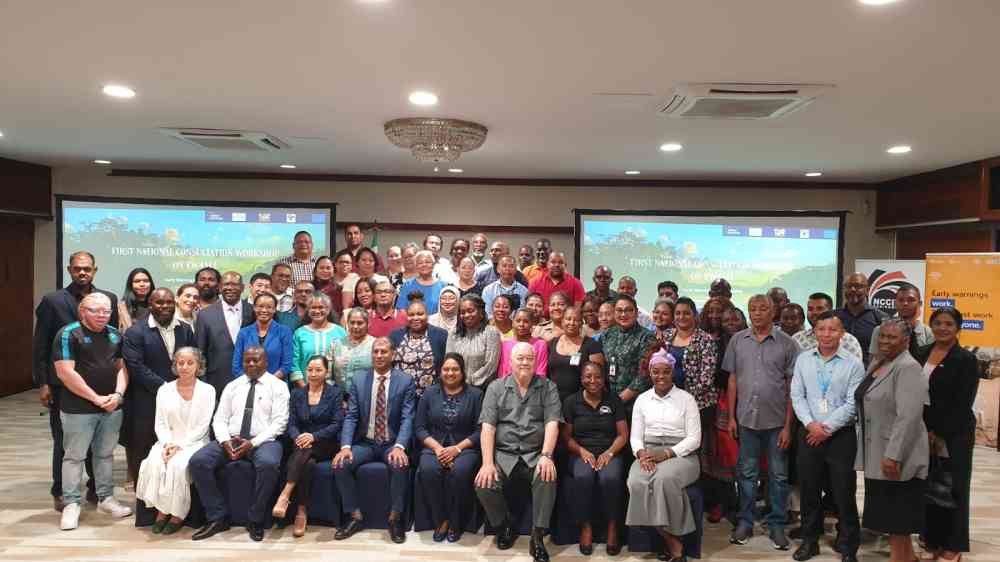
It was with this objective that more than sixty national experts and international partners convened in Paramaribo on 5 and 6 May 2026, bringing all relevant actors together for the first time within the Early Warnings for All (EW4All) framework. The two-day gathering offered a dedicated space to examine, jointly and openly, the gaps that stand between Suriname and a functioning national early warning system.
Drawing on a preliminary gap analysis informed by desk research and more than 25 stakeholder interviews, participants from disaster management, water management, meteorology, communications, humanitarian assistance, the private sector, academia and community engagement validated, refined and enriched the findings. Their discussions were structured around the pillars of the multi-hazard early warning value chain. These span disaster risk knowledge and management, the monitoring, observation and forecasting of hazards, the dissemination and communication of warnings, preparedness and response capacities, and governance as a cross-cutting dimension. The outcome is a gap analysis that more accurately reflects the country's current situation.
A global commitment, led nationally
This effort is being carried forward under EW4All, the global initiative led by the United Nations to ensure that everyone on Earth is protected by effective multi-hazard early warning systems by 2027. In Suriname, the National Coordination Center for Disaster Management (NCCR) leads implementation, with funding from the EU-Caribbean Resilience Programme (EU-CARES) and the Climate Risk and Early Warning Systems initiative (CREWS). Throughout the process, the four implementing partners of EW4All (UNDRR, WMO, ITU and IFRC) provided technical guidance across their respective pillars, reinforcing the quality and rigour of the analysis.
A shared responsibility across government and society
The development of an effective early warning system extends well beyond technical capacity. It is shaped by the territory itself, by where development takes place, how land use is planned, and which areas are prioritized for protection. Claudine Sakimin, Director of Spatial Planning at the Ministry of Public Works and Spatial Planning, described spatial planning and early warning systems as "two sides of the same coin of resilience." "An early warning system is only as strong as the physical landscape it serves," she said, adding that warnings can only be trusted when they rest on reliable data and reach people in a way that prompts action.
For this reason, the protection of people cannot rest with any single institution. "The Government has a duty to protect everyone," said Patrick Brunings, Minister of Oil, Gas and Environment, "but it cannot do so alone." Achieving it requires the sustained engagement of ministries, emergency management services, civil society organizations and international partners working in coordination, a principle that now underpins Suriname's approach.
Solutions within immediate reach
A significant outcome of the discussions was the recognition that not all identified gaps require additional funding. Several can be addressed in the near term through coordination alone.
The absence of a formal mechanism to assign roles among the organizations that comprise the system is one such example. Addressing it requires not financial resources but the willingness of stakeholders to convene and reach agreement. It has been proposed that the NCCR lead the establishment of such a coordination platform.
The NCCR's mandate is also expected to expand. At present, the institution operates under policy and operational constraints owing to the absence of a formal legal foundation. Legislation anticipated in early 2027 is expected to establish the NCCR as a fully independent authority under the Office of the President, with a dedicated budget and the standing required to lead disaster management effectively.
With the consultation phase concluded, a consolidated gap analysis report is being finalized, marking the completion of the first phase of the EW4All process in Suriname. The second phase will translate each priority gap into concrete action through a national roadmap, complete with budgets, timelines and clearly assigned responsibilities, to be developed by the end of 2026.
The foundations have been laid. The work of building now begins.