
Strengthening disaster risk communication in the Indian Ocean: Media and institutions work together in Mauritius

When early warnings are unclear or mistrusted, communities may ignore them — sometimes with life-threatening consequences. Clear and trusted communication is therefore a critical part of disaster risk management. However, In many countries institutional communicators and journalists operate under different pressures and timelines, which can complicate coordination during crises.
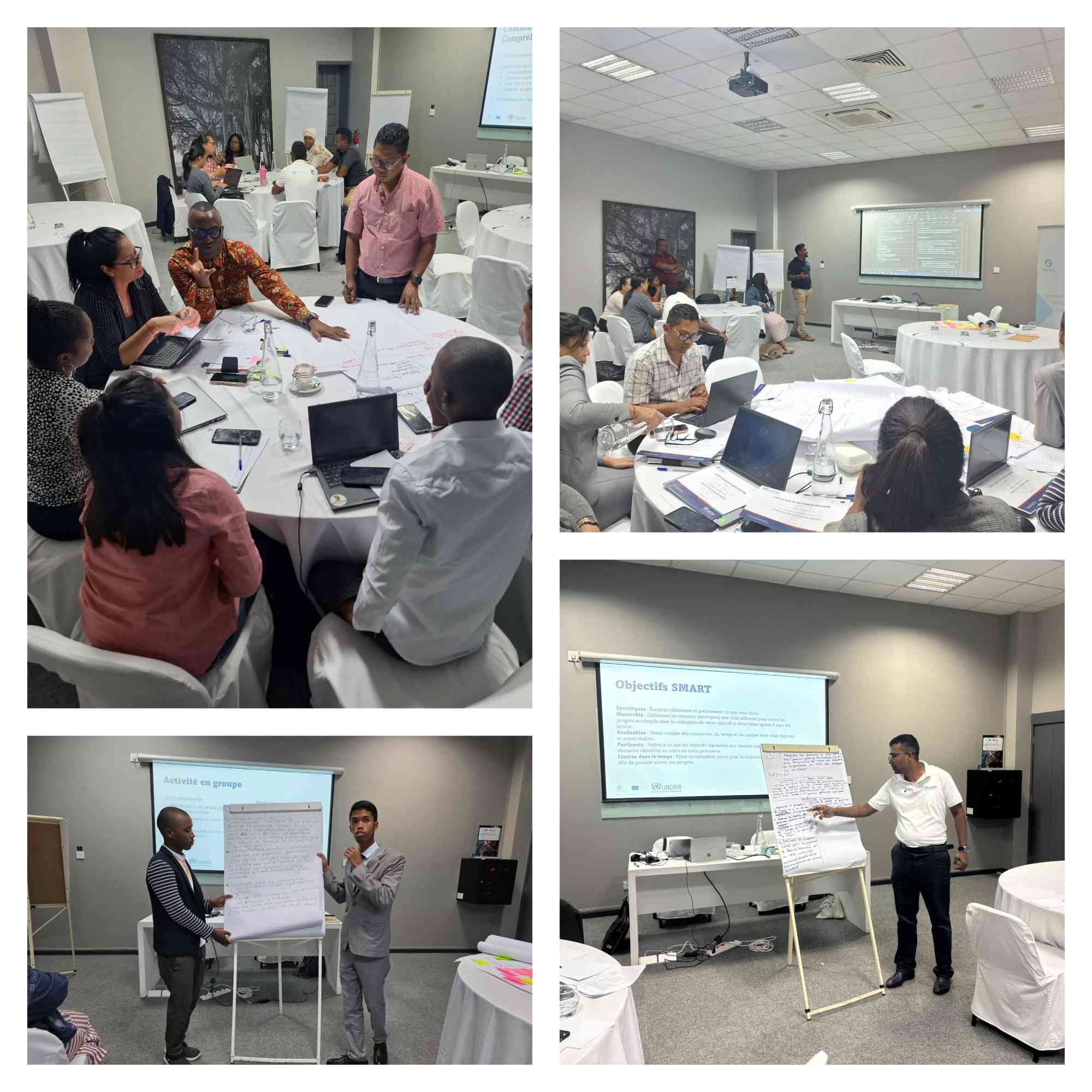
To address this challenge, the United Nations Office for Disaster Risk Reduction (UNDRR) organised a Regional Risk Communication Workshop from 9 to 11 March 2026 in Mauritius, bringing together institutional communicators, disaster risk experts, and media professionals from across the Indian Ocean region. The workshop was co-funded by the European Union (EU) in partnership with the Indian Ocean Commission (IOC) through the Resilience building and disaster response management in the Indian Ocean programme (RDRM-IO) programme 2020-2026.
By working together throughout the training, participants explored how stronger collaboration between institutions and the media can improve the clarity, credibility, and impact of risk communication before and during disasters.
Participation in the Regional Risk Communication Workshop has improved the NDRRMC’s communication strategy and shifted our approach by recognising the importance of diverse media channels beyond traditional platforms, enabling us to reach wider and more varied audiences more effectively.
Pravind Rughoo, Information and Communication Manager, National Disaster Risk Reduction and Management Centre, Mauritius
From awareness to behaviour-focused communication
The workshop was designed to move beyond traditional awareness messaging and focus on communication strategies that encourage protective behaviour in the face of disasters. Participants examined how people interpret risk information and discussed the factors that may prevent communities from acting on early warnings.
Resilience building and disaster response management in the Indian Ocean (RDRM-IO)
The overall objective of the Resilience building and disaster response management in the Indian Ocean (RDRM-IO) programme is to reduce disaster and climate related losses in the human, economic, social, physical, and environmental assets of Indian Ocean Commission (IOC) member states.
During an interactive exercise called the “disaster memory wall”, participants shared personal experiences of disasters and reflected on lessons learned in communicating risk. The activity helped create common ground between institutional communicators and journalists, allowing them to better understand each other's challenges and working environments.
Participating in the UNDRR Media Workshop 2026 was an enriching experience. It reinforced the importance of responsible journalism in disaster risk reduction and highlighted practical approaches to better reach vulnerable groups. As Managing Director of a media house in Seychelles, I see clear opportunities to apply these learnings in our daily work to improve access to critical information and strengthen community resilience. The workshop also emphasized the need for collaboration between media, authorities, and community actors to ensure that information is accurate, timely, and inclusive. These insights will guide us in refining our editorial strategies and in playing a more proactive role in preparedness and risk communication.
Veronica MARIA, Managing Director, Today Publishers, Seychelles
Participants were introduced to key disaster risk reduction concepts, including how hazards, exposure and vulnerability interact to create risk. Through interactive exercises, they mapped how these factors intersect in island environments and identified groups that may face greater barriers to responding to warnings.
Working in parallel groups, communicators and journalists began designing practical outputs tailored to their national contexts. Institutional communicators developed the foundations of a country-level risk communication campaign strategy, while journalists conceptualised a media programme that could strengthen public understanding of disaster preparedness and early warning systems.
Tackling misinformation and communicating uncertainty
Participants also examined how misinformation and rumours can spread during crises. Through joint brainstorming sessions, they analysed real examples of misinformation and explored strategies for both prebunking and debunking false information. Institutional communicators developed monitoring and response approaches, while media professionals discussed how investigative reporting and responsible sourcing can help maintain information integrity.
Having returned from Mauritius, I have a wealth of experience, both professionally and personally. This training allowed me to acquire new skills, connect with inspiring individuals, and strengthen my vision of engaged journalism in the face of current challenges. This significant step further motivates me to strive for high-quality, impactful work.
Girardo RAMAMBASOA, Editor-in-Chief, Televiziona Malagasy (TVM), Madagascar
Another key topic was communicating uncertainty. Participants were asked to craft a public message based on a heavy rainfall forecast with conflicting probability models. The challenge was to explain uncertainty while still encouraging protective action. Participants reflected on how risk information often involves probabilities and incomplete data, and how both communicators and journalists can explain uncertainty without undermining public trust.
The workshop evaluation indicates a clear shift in both confidence and understanding. At the outset, only one third of participants felt very confident in communicating risk information in ways that encourage protective action; by the end of the three days, this had increased to 75%. In parallel, a strong majority of participants came to recognize that risk communication is an ongoing process—not a one-off activity—and that its purpose is to drive behaviour change, not simply raise awareness.
The workshop reinforced that effective risk communication depends on strong collaboration between institutions and the media. Aligning how risk information is explained and reported helps communities to understand warnings earlier, trust the information they receive, and take action before hazards escalate into disasters.