
From risk awareness to action: Iraq advances SME resilience through interactive national workshop
How would a small business in Iraq cope with ten days of flooded roads, a week without electricity, or a month-long disruption to its supply chain?
These were among the practical challenges explored during the National Workshop on Strengthening SME Resilience in Iraq, held in Baghdad on 16–17 November 2026.
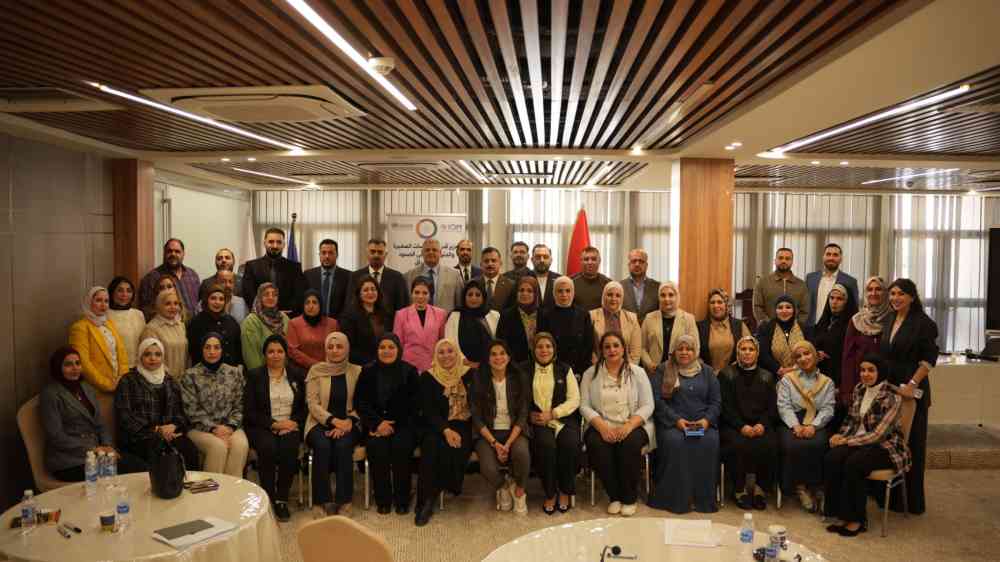
The two-day workshop brought together Iraqi government institutions, business representatives, entrepreneurs and development partners, including more than 12 women-led small and medium-sized enterprises (SMEs), to strengthen disaster preparedness, protect livelihoods and identify priorities for a national SME Resilience Roadmap.
Organized in collaboration with Iraq's Ministry of Planning, the International Organization for Migration (IOM) and the United Nations Office for Disaster Risk Reduction (UNDRR), the workshop connected disaster risk reduction with business continuity, economic recovery and local development.
The opening brought together senior representatives, including Dr. Maher Hammad Johan, Deputy Minister of Planning; Peter Hawkins, United Nations Resident Coordinator in Iraq; Pascal Rintjens, IOM Chief of Mission in Iraq; and Sandra Amlang, Chief of UNDRR's Regional Office for Arab States.
In her opening remarks, Amlang highlighted the wider importance of protecting small businesses:
"A small business may employ only a handful of people, but its survival can make a significant difference to an entire family or community."
Day 1: understanding risks and assessing business resilience
The first day examined the disaster, climate and displacement-related risks affecting Iraqi SMEs, including drought, water scarcity, extreme heat, dust storms, and flooding. Discussions also addressed how damaged infrastructure, interrupted supply chains, and limited access to finance can affect business operations and economic recovery.
UNDRR led technical sessions on disaster and climate risks affecting Iraqi enterprises and introduced its Resilience Maturity Assessment (ReMA) tool, which supports businesses in assessing their resilience capacities, identifying vulnerabilities, and prioritizing improvements.
Through a participatory resilience-mapping exercise facilitated by UNDRR and IOM, participants identified sector-specific hazards, existing capacities, institutional support mechanisms, and gaps in preparedness.
The discussions also considered the particular challenges facing displacement-affected enterprises, returnees and host communities, connecting SME resilience with broader recovery and livelihood priorities.
By bringing together experiences from different economic sectors, the exercise helped establish a shared understanding of the risks facing Iraqi businesses and the support needed to strengthen their resilience.
Day 2: translating risk knowledge into business continuity
Building on the first day's findings, the second day focused on practical business continuity planning and the development of Iraq's SME Resilience Roadmap.
UNDRR introduced key components of Business Continuity Planning (BCP), including identifying essential business functions, anticipating disruptions, establishing preparedness measures, and planning for recovery.
Participants then applied these concepts through interactive group exercises, considering how enterprises could maintain essential operations during disruptions such as flooding, prolonged electricity outages, supply chain interruptions and extreme heat.
The exercises encouraged participants to distinguish between measures businesses could implement independently and those requiring additional institutional, financial, or technical support.
Reflecting on the importance of translating risk knowledge into practical action, Rania Hammad, External Relations Officer at UNDRR's Regional Office for Arab States , emphasized:
"Building the resilience of small and medium-sized enterprises requires translating risk knowledge into practical business decisions. Through this national workshop with IOM, we are supporting SMEs in Iraq to identify disaster and climate risks, assess vulnerabilities and develop business continuity plans that protect livelihoods, sustain essential operations and strengthen recovery."
The practical sessions reinforced a central message: understanding risks is only the first step; businesses must also be equipped to anticipate disruptions, protect critical operations and recover effectively.
Women-led enterprises and inclusive economic resilience
A significant feature of the workshop was the participation of more than 12 women-led SMEs, bringing women entrepreneurs into discussions on disaster preparedness, business continuity and economic recovery.
Their participation helped ensure that the resilience challenges and support needs of women-led businesses were considered alongside those of other enterprises.
The workshop also addressed the vulnerabilities of businesses affected by displacement, underscoring the need for inclusive approaches that recognize the different circumstances in which Iraqi SMEs operate.
By connecting entrepreneurs with government institutions, business associations, and development partners, the discussions highlighted the importance of making resilience support accessible to enterprises with different capacities and resources.
Developing Iraq's SME Resilience Roadmap
The workshop concluded with a participatory process to identify priorities for Iraq's national SME Resilience Roadmap.
Drawing on the risk-mapping and business continuity exercises, working groups developed proposed actions, identified institutional responsibilities and potential partners, and considered indicative implementation timelines and technical support requirements.
Under the leadership of Iraq's Ministry of Planning, the process brought together complementary expertise. IOM contributed its experience in livelihoods, displacement-sensitive economic recovery and institutional support, while UNDRR provided technical guidance on disaster risk assessment, resilience measurement and business continuity planning.
These contributions supported efforts to establish a foundation for coordinated national action, linking enterprise-level preparedness with broader economic resilience and recovery objectives.
The next steps will focus on refining the proposed roadmap, strengthening institutional coordination and identifying opportunities for continued technical assistance.
Strengthening the resilience of Iraqi SMEs is not only about keeping businesses operational during disasters. It is about protecting jobs, sustaining livelihoods and enabling communities to recover and thrive in the face of future shocks.