
Returning to our roots: the value of ancestral knowledge in facing future challenges
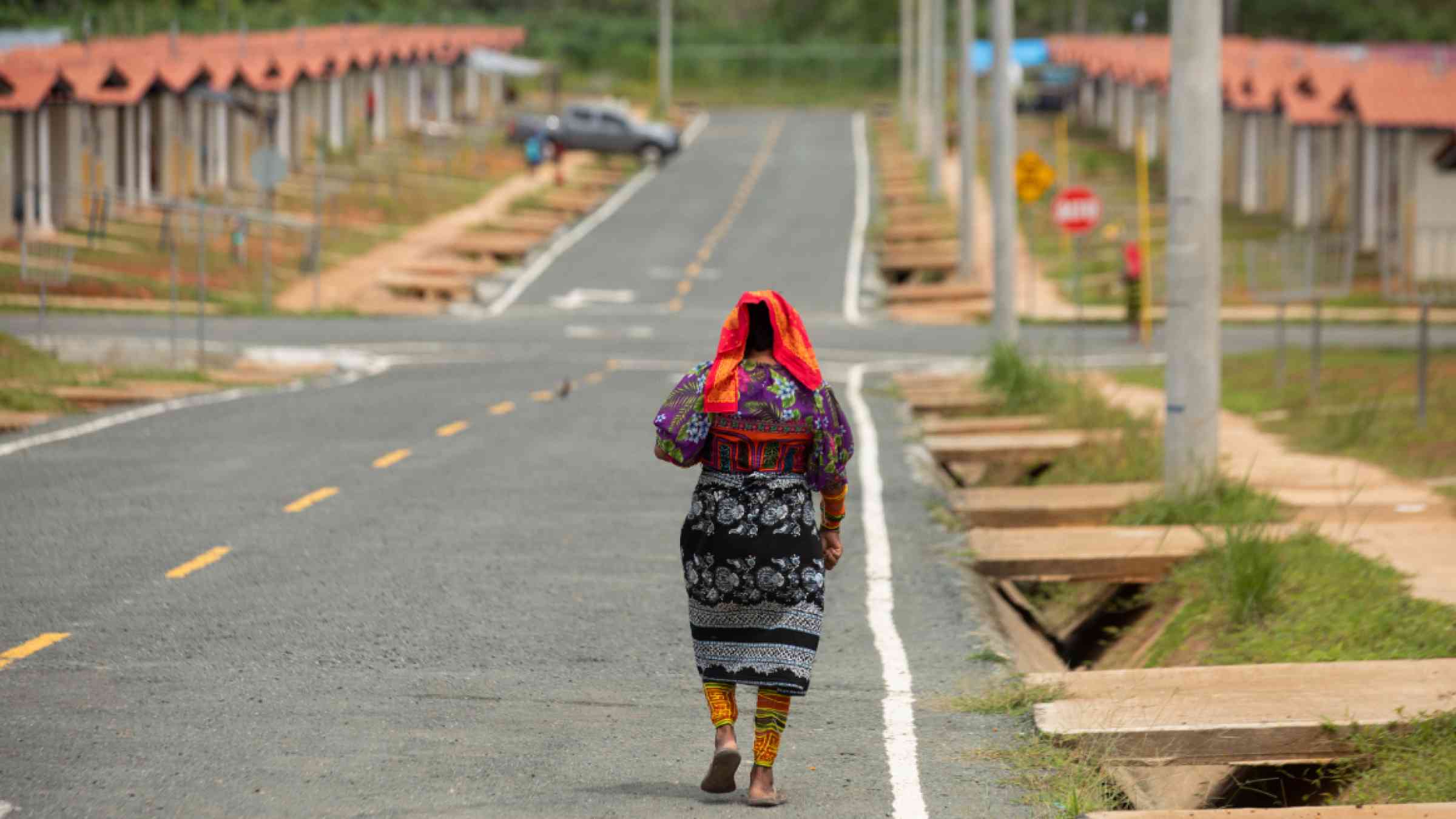
Despite being a school break, the streets of Isber Yala remain unusually quiet. The lively sounds of children playing are absent — perhaps due to the mid-morning heat or because this new setting has yet to feel like home.
Isber Yala is the newly inaugurated neighborhood created to house the community of Gardi Sugdub, one of the most densely populated islands of Guna Yala in the Panamanian Caribbean. This relocation is more than a simple change of residence; it is an urgent response to the looming hazard faced by the archipelago of over 350 islands, which is projected to be submerged by 2050 due to the relentless rise in sea levels.
For the Guna people, whose history and identity are deeply intertwined with the sea, the migration to the mainland signifies a profound shift. It demands adaptation not only to concrete houses and asphalt streets but also to new modes of food production and transportation. This transition goes beyond the physical — it entails a complete reconfiguration of their way of living and interacting with the world.
In this process, a crucial task emerges: to reshape their strategies for hazard prevention and preparedness, this time grounded in ancestral knowledge while remaining open to the demands of a new environment.
"Returning to mother earth, we must adapt our ancestral knowledge. At sea, we knew how to read the winds and tides; now we focus on the signs of the land, like the songs of birds or the behavior of animals," reflects Atilio Martínez, a Guna historian, as he sits on a wooden stool on his family's designated land for planting food. His words reveal the essence of this shift: the Guna people do not abandon their wisdom — they transform it.
The story of Isber Yala mirrors the broader challenges faced by other Indigenous communities across Latin America and the Caribbean. The region, exposed to a range of hazards, has seen landslides, floods, storms, and droughts disproportionately impact Indigenous populations. In response to these challenges, ancestral knowledge has become a key pillar of resilience.
This knowledge, passed down from generation to generation, enables communities to anticipate and adapt to different hazards. As Ismael García, from the Lenca people of Honduras, puts it, "our ancestors had their own way of understanding warnings, but we must be attentive to the perspectives of young people, as they hold the key to today’s problems. Both forms of knowledge must engage in dialogue."
Ancestral knowledge extends beyond practical techniques, embodying a symbolic and spiritual connection with nature. From observing animal behavior to monitoring lunar cycles and weather patterns, Indigenous people have developed sophisticated early warning systems. Today, these systems must interact with scientific monitoring methods.
The relocation of Gardi Sugdub’s community to Isber Yala is not only an example of climate displacement but also a testament to the evolution of ancestral knowledge. This experience echoes other contexts. In Intibucá, Honduras, Lenca communities have likewise had to adjust their traditional practices due to ecological changes. For Lorena Terrazas of the Latin America and the Caribbean Women's Network for Disaster Risk Reduction, "it is essential for Indigenous communities to be involved in consultations and decision-making processes related to risk management and reduction policies."
The Sendai Framework for Disaster Risk Reduction 2015-2030 emphasizes the importance of integrating ancestral and Indigenous knowledge into risk reduction strategies. In this vein, the United Nations Office for Disaster Risk Reduction (UNDRR) has published the guide “Words into Action: Using Traditional and Indigenous Knowledges for Disaster Risk Reduction”, which promotes the inclusion of these knowledges in risk reduction policies to ensure they are both culturally appropriate and effective.
The recent event “Voices for Resilience: Traditional and Indigenous Knowledge for Disaster Risk Reduction” convened Indigenous leaders, risk management experts, and knowledge network representatives to highlight the value of this knowledge. Dalí Ángel, from the Indigenous Knowledge Network for Disaster Risk Reduction, stressed, "the recognition of Indigenous knowledge is essential, as are spaces for coordination on equal footing. Networking is essential to achieve this."
While Indigenous communities face multiple challenges — climate change, forced migration, loss of territory — they also possess the capacity to contribute to global resilience. Their environmental management practices, such as the terraced water systems of Mexico or the stone walls of Peru designed to stabilize mountain terrain, illustrate the enduring relevance of their knowledge.
"In the face of these risks, within a region rich in cultural and ecological diversity, Indigenous knowledge plays a fundamental role in disaster risk reduction. Passed down through generations, it enables communities to foresee and adapt. The environmental management practices developed over centuries reflect an integrated resilience in ecosystems and territories, complementing scientific knowledge and providing sustainable, locally adapted solutions," says Nahuel Arenas, chief of the UNDRR Regional Office for the Americas and the Caribbean.
The challenge lies in ensuring that governments and institutions recognize and value this knowledge. It must be incorporated into early warning systems, climate change adaptation policies, and risk reduction strategies. For Rodrigo Hernández Escobar of the Indigenous Knowledge Network for Disaster Risk Reduction, the key is to foster the exchange of good practices and establish platforms to document successful experiences and methodologies.
As the children of Isber Yala explore their new surroundings, the Guna people confront a crossroads that is also faced by other Indigenous communities across Latin America and the Caribbean: the need to adapt their ancestral knowledge to an ever-changing world.
This adaptation does not imply abandoning their roots but rather transforming them to confront new realities. The resilience of communities depends on their ability to merge ancestral knowledge with modern approaches — to foster dialogue between traditional wisdom and scientific insight.
"Our culture will not change, only certain elements will shift, but our identity will remain intact, as we love nature. Here in Isber Yala, too, we will continue to love our culture," declares Nele Victoria Navarro, the spiritual leader of the community. She speaks with conviction, sitting in a hammock surrounded by pots and cookers still fragrant with the scent of stew. Resting under her arm is a mola, a fabric that showcases the Guna people’s most vibrant artistic expressions, often depicting marine elements like turtles, lizards, and fish. "When we first began sewing molas, they were geometric figures, then came the fish. So, the mola will not change either; we just have to return to our roots," she says, pulling a pin from her skirt.