
Putting risk communication at the heart of disaster preparedness
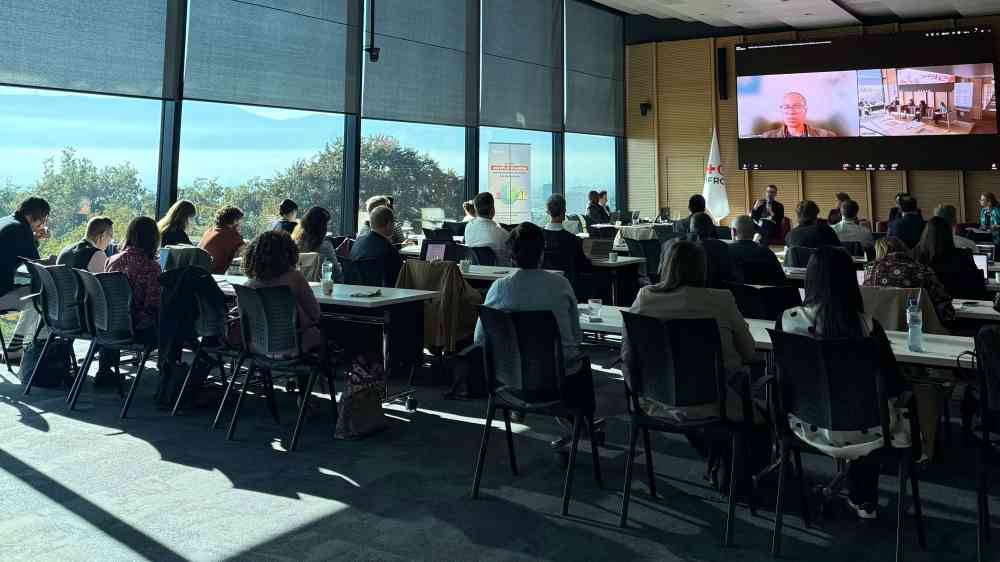
Why do people sometimes fail to act on disaster warnings, even when information is available? How can institutions ensure that risk information reaches those who need it most? And what does it take to turn awareness of risk into life-saving action?
These questions brought together experts from international organizations, media, telecommunications, academia and civil society in Geneva on 14 October for “From knowledge to action: Communication for a safer world”, as part of a series of events marking the International Day for Disaster Risk Reduction 2026 and its “Resilience Starts at Home” theme.
The event was organized by the United Nations Office for Disaster Risk Reduction (UNDRR), the United Nations Educational, Scientific and Cultural Organization (UNESCO) and the International Federation of Red Cross and Red Crescent Societies (IFRC), with support from the Government of Switzerland. The event’s day long sessions were attended by government officials, international aid workers, researchers, journalists, and communication specialists from Geneva and beyond. The event attracted strong participation, with 47 attendees joining in person, 203 online, and more than 3,000 viewers tuning in to the LinkedIn livestream segment.
The keynote presentation was delivered by Mr. Ed Celebi-Morrow, of the Lloyd’s Register Foundation, who shared some insights from the latest World Risk Poll 2026. The most notable was that four in five people who had experienced a disaster in the previous five years reported receiving at least one warning beforehand. Yet only 64% of those who received a warning said they were able to take action because of it. The findings underscore the importance of moving beyond the dissemination of information to ensure that people have the knowledge and capacity to respond.
Speaking at the event, Ms. Paola Albrito, Director of UNDRR, emphasized that “The measure of effective risk communication is not simply whether information has been delivered. It is whether people are better able to understand their risks, make informed decisions and take action to protect themselves and their communities.”
Understanding information risks
The first morning panel explored vulnerabilities that can prevent people from receiving, understanding, trusting or acting on risk information. From misinformation and language barriers to unequal access to communication channels and disruptions to telecommunications infrastructure, these challenges can undermine the effectiveness of even technically accurate warnings.
Current and former representatives from Informed, the Red Cross Red Crescent Movement Hub on Harmful Information, GSMA and BBC Media Action examined information risks from the perspectives of media, humanitarian action and mobile connectivity.
The session drew attention to the importance of identifying communication vulnerabilities before disasters occur, so that they can be considered alongside other risks in preparedness planning.
Building the foundations for effective risk communication
Effective communication requires more than well-crafted messages. It depends on institutions, systems and partnerships that are established and tested long before a crisis.
The second panel brought together perspectives from UNESCO, the Comoros National Council for the Press and Audiovisual Media, the Caribbean Broadcasting Union and IFRC to explore how communication can be more systematically integrated into disaster risk governance. Discussions addressed institutional responsibilities, coordination with media and telecommunications partners, readiness to counter harmful information.
The programme also highlighted the importance of media resilience and the role of trusted information providers in helping communities understand risks and take appropriate action.
From information to action: What shapes our decisions?
Even when people receive and understand a warning, their response is not determined by information alone.
A dedicated LinkedIn Live discussion featuring Dr. Tobias Brosch, Professor of Psychology at the University of Geneva, explored the behavioural factors shaping how people perceive risks and make decisions under uncertainty.
Building on this theme, an interactive session facilitated by Dr. Lara Mani of the University of Cambridge invited participants to engage with the practical challenges of managing risk communication through the Risk Comms Ready! exercise.
Together, these sessions brought a human-centered dimension to the discussion, highlighting the need to account for how people interpret information and navigate decisions in real-world circumstances.
Closer to home: from information to connection
The final panel shifted attention to how risk communication is serving local communities.
Featuring perspectives from creative communicators, community radio, academia and humanitarian contexts, the session explored how local knowledge, language, culture and trusted community voices can make risk information more relevant and accessible.
Contributions from Pacifico, the Association of Community Radio Broadcasters Nepal, the University of Cambridge and IFRC's Global Disaster Preparedness Center provided examples of approaches that connect technical risk information with people's everyday realities.
The discussion placed particular emphasis on the role of communities not only as recipients of information, but as active participants in shaping how risks are communicated.
From knowledge to action
The event highlighted the breadth of expertise needed to strengthen risk communication, spanning disaster risk management, media development, telecommunications, behavioural science and community engagement.
Its central message was that effective risk communication is not simply about informing people that danger exists. But it is a dynamic process that requires understanding the barriers to action, investing in trusted and resilient communication systems, and ensuring that communities are co-creators in preparedness efforts.
Strengthening these foundations is essential to turning risk knowledge into practical action and advancing the goals of the Sendai Framework for Disaster Risk Reduction 2015–2030.
The recording of the sessions "Understanding information risks" and "Building the foundations for effective risk communication" is available here.
The recording of the session "Closer to home: from information to connection" is avalable here.