
The first international Youth AGI Artwork competition for Tsunami responding to disasters officially begins!
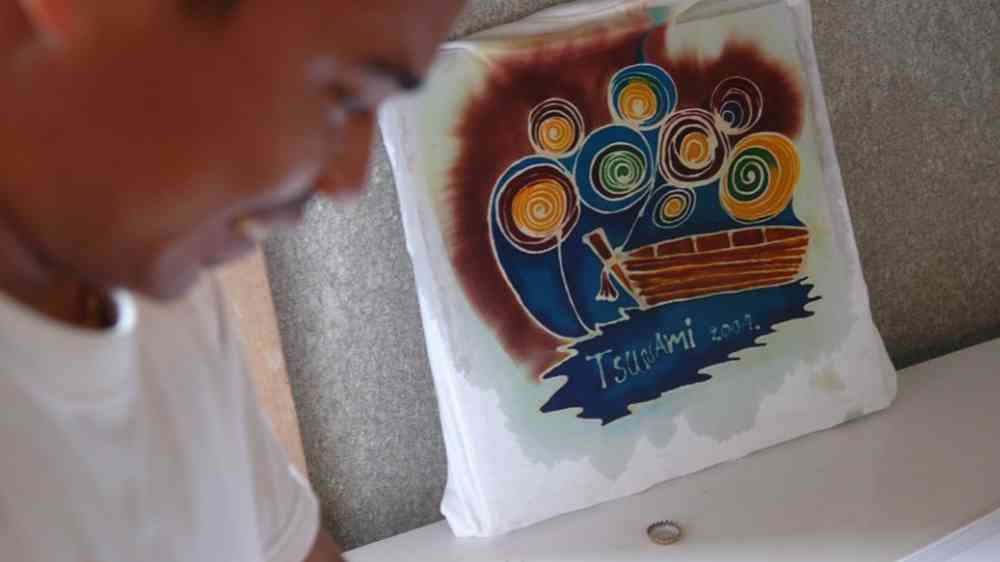
This photo was taken in the aftermath of the 2004 Indian Ocean earthquake and tsunami. In response to the crisis, the ILO, governments, employers' and workers' organisations engaged in the largest regional income generation and employment creation ever.
Date 22 October - 15 December
In 2015, the United Nations General Assembly designated November 5th of each year as "World Tsunami Awareness Day." With global climate change, the risk of extreme marine disasters continues to intensify. As the core reserve force for future disaster prevention and mitigation, cultivating disaster resilience and technological innovation capabilities among young people is of great significance.
Artificial General Intelligence (AGI) technology offers a new technological approach for overcoming tsunami warning blind spots, optimizing emergency escape routes, upgrading rescue plans, and post-disaster reconstruction. To guide global youth in using AI technology to think about real-world tsunami disaster response, disseminate scientific knowledge on disaster prevention and mitigation, and build an international platform for youth science and technology innovation exchange on disaster prevention and mitigation, the first International Youth AGI Works Competition on Tsunami Disaster Response was officially launched. This initiative is supported by the International Exchange and Cooperation Center of the Ministry of Emergency Management, the Academic Committee of the China Educational Technology Association, and the Haidian District Education Commission, and is guided by the United Nations Office for Disaster Risk Reduction (UNDRR) and the United Nations University Institute for Macau Studies (UNU Macau), and hosted by the Risk Governance Innovation Research Center of Beijing Normal University.
This event is open to school-aged youth worldwide and encourages participants to use AGI/AIGC tools to create innovative works on tsunami prevention and mitigation, promoting the use of youth scientific and technological achievements to serve the global cause of disaster risk governance.
Call for Submissions
1. AI-generated images (science posters) (Elementary school students only)
2. AI Videos on Tsunami Prevention and Mitigation (Elementary School Group, Middle School Group, University Group)
3. Tsunami Disaster Relief Robot Design (Elementary School Group, Middle School Group, University Group)
4. Tsunami Response AI Mini-Program/App Design (Elementary School Group, Middle School Group, University Group)
5. Emergency Policy Recommendations and Tsunami Disaster Management Case Studies (University Group Only)
General Creative Requirements
All entries must revolve around the theme of tsunami prevention and mitigation, and the topics can cover tsunami warning, popular science education, emergency escape and evacuation, disaster relief, post-disaster psychological intervention, and post-disaster recovery and reconstruction.
The work must be completed independently by the participants, using AGI/AIGC tools as an auxiliary means. Participants must have made substantial original intellectual contributions and should explain their independent creative behaviors, such as prompt word design, scheme conception, parameter adjustment, content selection, and logical design, when submitting their work.
Plagiarism and misappropriation of third-party images, audio, code, documents, and other materials are strictly prohibited, and multiple submissions of the same manuscript are not allowed.
Open-ended design is encouraged. Submit your work materials to [email protected]. University applicants may also submit a feasibility analysis report, including cost estimates and descriptions of potential application scenarios.
Detailed rules for submitting materials for each section
AI Image (Science Popularization Poster) (Elementary School Group Only): Submit a high-resolution JPG/PNG image, any aspect ratio, within 20MB, and a PDF description of the work (within 50MB, including the science popularization content of the poster, the tools used, key words, etc.).
Tsunami Prevention and Mitigation AI Video (Elementary School Group, Middle School Group, University Group): Submit the finished video in MP4 format, with an aspect ratio of 16:9, less than 500MB, and a duration of 2-5 minutes. Accompanying
the video is a PDF description of the work (less than 50MB, including creative ideas, AI tools, key words, etc.).
Tsunami Disaster Relief Robot Design (Elementary School Group, Middle School Group, University Group): Submit design drawings, renderings, demonstration videos, and PDF technical documents explaining the functions, technical principles, and application scenarios in disaster scenarios.
Tsunami Response AI Mini Program/App Design (Elementary School Group, Middle School Group, University Group): Submit a prototype demonstration video, design document, core code snippets (if any), and an explanation of the system's usage process in a tsunami disaster.
Emergency Policy Recommendations and Tsunami Disaster Management Case Studies (University Group Only): Research report PDF, which can be accompanied by a presentation video, including case analysis, policy optimization recommendations, and feasibility assessment.
Event schedule
The event is divided into three stages: submission of works, selection of works, and summary and commendation ceremony. Outstanding works will be exhibited online and offline in an international setting.
Judging rules
- Scientific accuracy 40%: Closely related to the theme of tsunami prevention and mitigation, accurate disaster knowledge, plans that conform to the objective laws of disaster response, and rigorous logic.
- Innovation 30%: The application of AGI/AIGC technology is innovative, breaking through traditional disaster reduction science popularization and solution ideas with innovative design.
- Feasibility 30%: The technical path is clear and reasonable, and matches the ability boundaries of the corresponding educational stage; the primary school group accepts the conceptual idea, while the university group prioritizes the practical verification and social value.
Awards
The following awards are set up according to the primary school group, secondary school group, and university group:
- Special Prize, First Prize, Second Prize, and Third Prize;
- Certificate of Outstanding Works: All shortlisted participants will receive a certificate of excellence.
- Certificate of Outstanding Instructor;
- Certificate of Outstanding Organization;
We welcome participation from university, middle school, and primary school students worldwide! For submissions or inquiries, please contact: [email protected] .