
Count what matters: non-economic losses symposium in the Pacific

“What we lose cannot always be counted. But it must always count.”
Hu‘akavameiliku, the Pacific Political Champion for Loss and Damage, delivered this message during his pre-recorded opening remarks to the Pacific Symposium on loss and damage. The symposium was held in Nadi, Fiji from 28-29 September 2026, bringing together over 70 participants from local communities, Indigenous Peoples, governments, regional and international organizations, among other stakeholders.
The event preceded the preparatory, informal sessions of the 31st Conference of the Parties to the Climate Change Convention (Pre-COP 31), held from 5-8 October 2026 in Fiji and Tuvalu in partnership with the Government of Australia. The symposium provided an opportunity to consider Pacific perspectives and priorities on non-economic losses ahead of these discussions.
Participants discussed how non-economic losses (NELs) are experienced across the Pacific, ongoing responses, and opportunities for further action. Dedicated sessions were held on NELs related to culture, heritage and identity; biodiversity and ecosystem services; health and wellbeing; and climate mobility.
In setting the tone for the symposium, Mr Joeli Ditoka, Deputy Permanent Secretary Policy, Ministry of Itaukei Affairs, welcomed the symposium as an opportunity to identify practical pathways for addressing NELs. While recognising the profound consequences of NELs on culture, language, sense of place, connection to land and ocean, and identity, among others, he also gave a call to action. In it, he called for improved measurement and understanding of the impact of NELs, enhancing policies, strengthening disaster risk reduction (DRR) and climate frameworks and ensuring Indigenous Peoples are partners in all processes to address NELs.
Villi Iese from the University of Melbourne, who moderated the symposium, encouraged participants to advance and drive Pacific-led approaches and solutions, noting, “‘Our symposium, our loss, our solutions.” He also highlighted the importance of applying these solutions locally and regionally, while sharing Pacific experiences and approaches for global action.
Several countries, regional entities and international partners provided an overview of the progress, challenges and solutions of the region. It emphasized NELs as a complex, value-based, and pervasive issue, manifesting in communities and sectors in different ways; but one that unifies the region despite cultural, physical and socio-economic diversity.
A key reflection from participants was the central role of Indigenous and traditional knowledge. Participants highlighted the importance of incorporating traditional knowledge, values and lived experience into how NELs are understood, assessed and addressed. Issues related to consent, ownership and the protection of Indigenous knowledge and data were also raised.
Greater coordination was identified as necessary for building on the progress made thus far. Participants noted the need for coordination across sectors, levels of governance and organizations to reduce fragmentation and duplication and, where appropriate, improve coherence among approaches to NELs.
This coordination extends to the policy landscape. The “policy space is a living one…shaped by…people who participate in them” according to Tina Newport of the Cook Islands, and echoed through the symposium.
Data was a clearly identify gap, both the availability and accessibility. It is foundational for sufficiently identifying how NELs affects communities and countries. How data is collected, managed, shared and used should also take account of ownership, consent and relevant safeguards, including in relation to Indigenous Peoples and local communities.
Among the outcomes of the symposium were recommendations for the Pacific Loss and Damage Political Champion. These messages reemphasized the losses that go beyond monetary terms, and must be addressed urgently,and the importance of ensuring that Pacific voices and solutions inform the way forward. They also recognised that the diverse nature of NELs requires diverse methodologies, and can serve to enhance access to finance to respond accordingly.
The event concluded with participants’ recommendations and actions to maintain the momentum beyond the symposium. These called for strengthened capacity to drive implementation, and ensuring harmonisation and participation through an evidence-based approach. Finance and technical assistance were central to the action points, noting the opportunities presented from regional and international mechanisms.
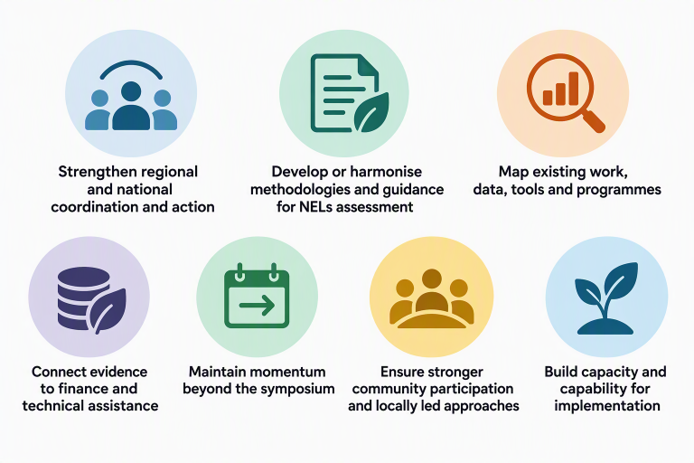
Building on the symposium’s outcomes, several side events during the Pacific Pre-COP highlighted non-economic losses across the Pacific and explored practical solutions, helping to advance the symposium’s recommendations. The Pacific Political Champion for Loss and Damage called for a technical advisory group to support his advocacy and follow-up, raise awareness of non-economic losses, and promote greater consistency in assessment methodologies while respecting diverse Pacific contexts and locally led approaches.
The symposium provided a platform for continued exchange on approaches to NELs in the Pacific and identified areas for follow-up related to evidence, policy, capacity, coordination, finance and technical assistance. Its outcomes are expected to inform continued regional dialogue and engagement on NELs.