
Bonn technical forum 2025 - Regional pathways to comprehensive risk management

12 December 2025| UN Campus Bonn, Germany
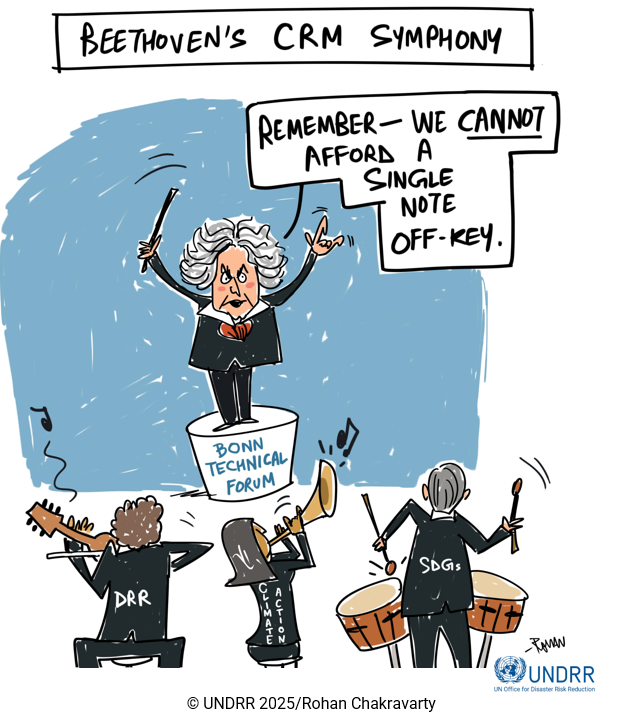
The recently concluded 30th United Nations Climate Change Conference (COP30) and the Global Platform for Disaster Risk Reduction highlighted the growing challenges posed by the climate emergency, and the need for coherent approaches to address the emergency and build the resilience of countries and communities. While the importance of policy coherence has been widely acknowledged, turning this into action has remained a challenge. The United Nations Office for Disaster Risk Reduction (UNDRR) has been taking steps to promote and pursue coherent approaches through a Comprehensive Risk Management (CRM) approach.
This was the focus of the 2025 Bonn Technical Forum, an annual convening of global community on a topical issue. Twenty representatives from 16 regional inter-governmental organizations participated in the 2025 staging of the Bonn Technical Forum. The forum deep dived into Regional Pathways for Comprehensive Risk Management for Integrated Disaster Risk Reduction and Climate Action on 2 and 3 December 2025 in Bonn, Germany.
The forum was considered timely, being held against the backdrop of the 10th anniversary of the adoption of the 2030 Agenda for Sustainable Development, the Sendai Framework for Disaster Risk Reduction and the Paris Agreement, all of which were adopted in 2015. A key message that emerged, therefore, was the need for more integrated approaches to climate action and disaster risk reduction (DRR) - the heart of CRM - in institutional structures, policies and financial arrangement at the national, regional and international levels.
In reflecting on the outcome of COP 30, Elisa Calliari, Co-Chair of the Executive Committee (ExCom) of the Warsaw International Mechanism for loss and damage, and a member of its Technical Expert Group on CRM (TEG-CRM), welcomed the call for, "a focus on compound and cascading risk, to strengthen our work on methodologies for assessing economic and non-economic loss and damage, how to integrate loss and damage consideration into national response plans."
The recently launched "Global Synthesis Report on Comprehensive Risk Management: Charting a path towards resilient futures" report provided a snapshot of positive examples of integrated approaches across different regions. The regional organizations, through peer-to-peer exchanges, also shared examples from their regions. Caroline Tagwireyi, representing the African Union, stated that, "through the Sustainable Environment and Blue Economy Directorate, we champion a unified approach to safeguarding Africa's future. We also recognize, as many have noted, that disaster risks are linked to climate change. It is essential that we work together across units to implement our strategies, so they protect lives, livelihoods, and development gains across the continent."
While CRM approaches are growing, many challenges remain. In this regard, the intergovernmental organisations expressed support and commitment to addressing these barriers, both within their respective organizations as well as the regions they serve.
The role of data was underscored as important for resilience, including for understanding risk and the impact of climate and disasters on vulnerable populations. It was further explored in the second segment of the Bonn Technical Forum, titled "Data as a lever for climate action", held from 3-5 December 2025.
Partnerships emerged as a necessary enabler for holistic action. The Forum was therefore a starting point for building and strengthening partnerships within and across regions, including with UN entities such as UNFCCC and UNDRR. It is also important for national level resilience. In her remarks, Katharina Lotzen (GIZ) acknowledged the diversity of partnerships necessary for success in building resilience to climate change and disasters, including stakeholders from the local level and those supporting action on the ground. She further stated that a comprehensive approach is necessary, as without it, "to tackle all these as separate topics, it's wasting a lot of resources."
Finance and technical assistance were other enablers explored at the workshop. Among the opportunities available to developing countries, mostly served by the organizations present, were: the Santiago Network, providing technical assistance for activities relating to loss and damage; the Adaptation Fund, through grants for adaptation and DRR at the regional to subnational levels; the Green Climate Fund (GCF), with diverse financial instruments at varying scales; the Global EbA Fund, for resources to support ecosystem-based adaptation and resilience; and the Fund for responding to Loss and Damage, including the Barbados Implementation Modalities (BIM) for which a call for proposals of was recently announced.
Thanking all the intergovernmental organisations for their active participation, Animesh Kumar, Head of the UNDRR Bonn Office, asserted that, "Risks are increasing while finance remains limited. However, if we work together, breaking the silos across institutions, policies and implementation, we can maximize available resources and unlock new finance - there is a strong business case for coherence."
The workshop concluded with a reminder that drivers of risk - climatic and non-climatic - act together to create and increase existing risk; therefore, resilience cannot be built if risk understanding, planning and financing actions operate in silos. It was further reaffirmed that integrated approaches are necessary at all levels of society, and inter-governmental organizations at the regional level can play a crucial role in translating this into action at the national and sub-national levels.