
Advancing resilience by transforming flood risk data into meaningful action in Côte d’Ivoire
Côte d'Ivoire faces a range of natural hazards, including floods, droughts, and occasional seismic risks. The country is particularly vulnerable to floods and droughts, which are exacerbated by climate change and climate variability. Flooding events often result from intense rainfall, causing damage to infrastructure, agriculture, and livelihoods. Such hazards require integrated risk management approaches to enhance resilience and reduce vulnerabilities across the country.
To enhance the risk management approaches available to Côte d’Ivoire, the United Nations Office for Disaster Risk Reduction (UNDRR), alongside the CIMA Foundation, provided technical support to the country to develop a national flood risk profile. This risk profile combines historical flood hazard data with several risk indicators to create a holistic picture of potential damage and economic loss that could be incurred during future flooding events. The profile’s platform produces accurate loss and damage projections for the 2050-2100 period and considers a diverse range of possible scenarios, their likelihood, and associated impacts. This achievement marks an important step in the right direction, as the development of this risk profile was identified as a key result in Côte d’Ivoire’s 2020-2030 national DRR strategy.
The national DRR platform for Côte d’Ivoire played a pivotal role in enabling the development of the risk profile. It mobilized the involved stakeholders, and functioned as the leading coordination mechanism to bring together actors from various sectors
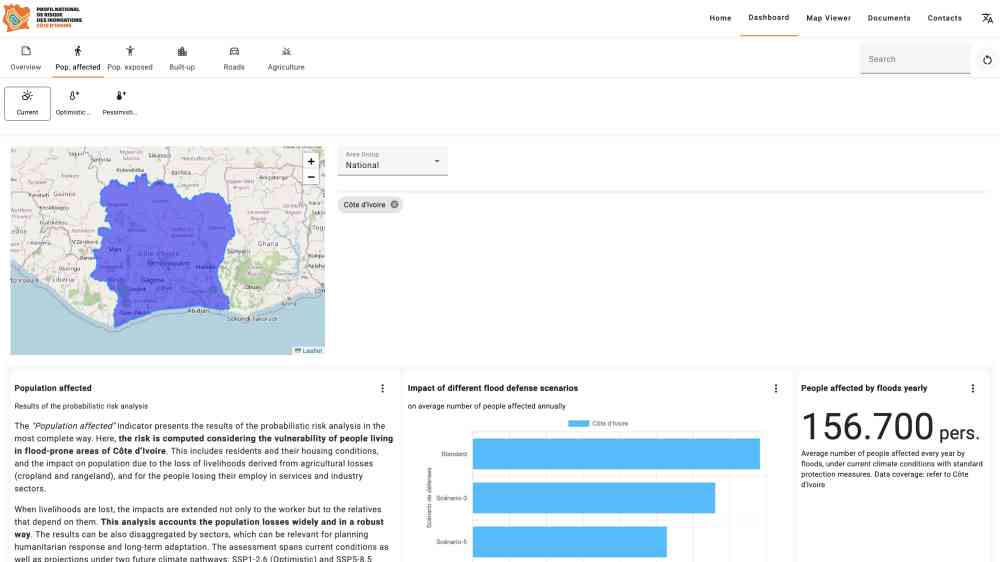
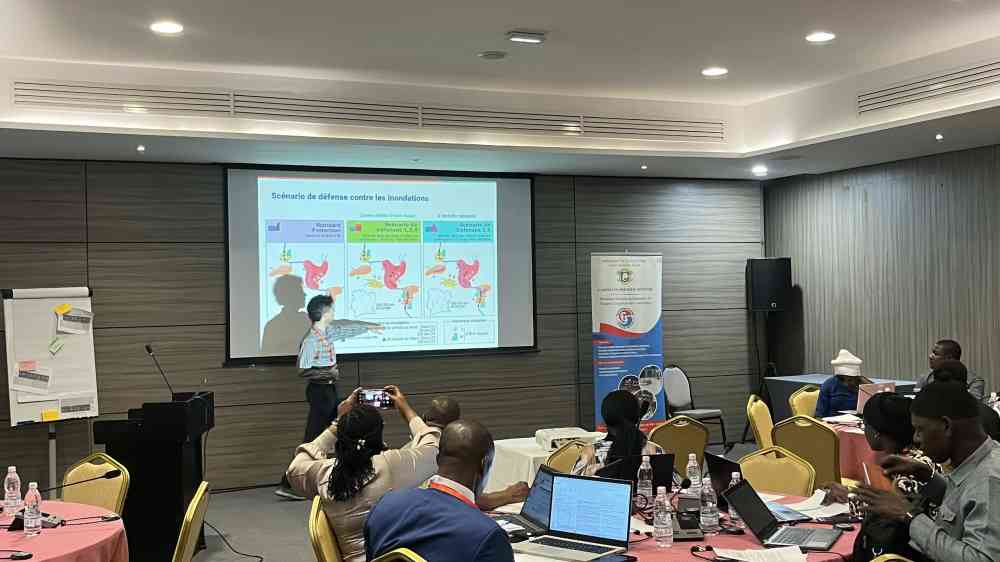
To officially present and validate the national flood risk profile, as well as share it with decision-makers, UNDRR and the Government of Cote d’Ivoire co-organized an event from 1 to 3 December 2025. Through this process, the profile became a recognized national reference to inform risk reduction measures specific to the country’s context. Government institutions and other stakeholders gained direct access to flood risk data, scenarios, and district-level projections. Ivorian stakeholders also received training on using the online risk profile platform to integrate risk information into urban planning, land-use planning, and development strategies. The event was held in collaboration with CIMA Foundation, Italian Agency for Development Cooperation (AICS), and the Italian Ministry of Foreign Affairs, and was funded by the Government of Italy.
A key aspect of the event was in how it shifted the focus to flood risk management as an investment in disaster risk reduction rather than a reactive humanitarian response undertaking. For example,risk information was highlighted as a tool for budget allocation, infrastructure protection, and anticipatory action. The workshop built on Côte d’Ivoire’s national DRR platform, aligning actions with national policies and strengthening anticipatory governance.
As part of fiscal-informed public investment planning, the risk profile platform also presented cost benefit analysis (CBA) for flood defense drawn from the developed risk profile. The CBA results, based on a national full‑network flood defense system (covering 8,500 km and designed for 100‑year floods), was projected to reduce average annual losses by 20–40%, at a cost less than 4% of Côte d’Ivoire’s 2026 national budget (USD 31.58 billion), an amount comparable to the USD 1.1 billion already allocated to road infrastructure for 2025. This quantified economic value of resilience investments reinforces the case for allocating resources towards preventive action.
The workshop promoted regional cooperation through dedicated exchange days where countries from the Sahel and West Africa shared national experiences. Delegates from Niger, Chad, Senegal, Nigeria, Benin, and Togo joined to learn from Côte d’Ivoire’s advanced risk profile and its potential for decision-making. Sessions were dedicated to peer exchanges, enabling West African countries to share experiences and strengthen regional collaboration. Discussions allowed participants to compare how risk information is used in planning and how risk information feeds into Early Warning Systems and anticipatory financing.
“With this tool, Côte d'Ivoire takes a significant step forward, having previously lacked a solid technical foundation to anticipate, prevent, and reduce the effects of floods, complementing our existing national mechanisms. The government attaches particular importance to the maintenance, continuous updating, and sustainability of this digital platform.”
- Assahoré Konan Jacques, Minister of the Environment, Sustainable Development and Ecological Transition, Côte d'Ivoire
The event set out long-term goals for West African countries to improve national risk profiles and integrate risk information into development planning, risk financing, early warning systems and anticipatory financing. The development of cross-border data sharing protocols and Standard Operating Procedures was emphasized, and national efforts were aligned with regional frameworks such as the Africa Multi-Hazard Early Warning and Early Action System (AMHEWAS) and ECOWAS.
The workshop emphasized the importance of strengthening institutional capacities and applying scientific tools to inform decision-making and improve preparedness. By transforming scientific data from the National Flood Risk Profile into actionable resilience measures, Côte d’Ivoire advanced its ambition to better protect vulnerable populations through impact-based forecasting and early actions.
By fostering a common understanding of shared hydrometeorological risks and emphasizing transboundary collaboration, the workshop laid the foundation for stronger regional resilience. Côte d’Ivoire’s leadership in validating and operationalizing its flood risk profile provides a model for neighbouring countries to follow, ensuring that scientific data translates into effective preparedness and protection for communities across West Africa.