
Advancing Early Warnings and Extreme Heat solutions: UNGA 80 Dialogue urges action
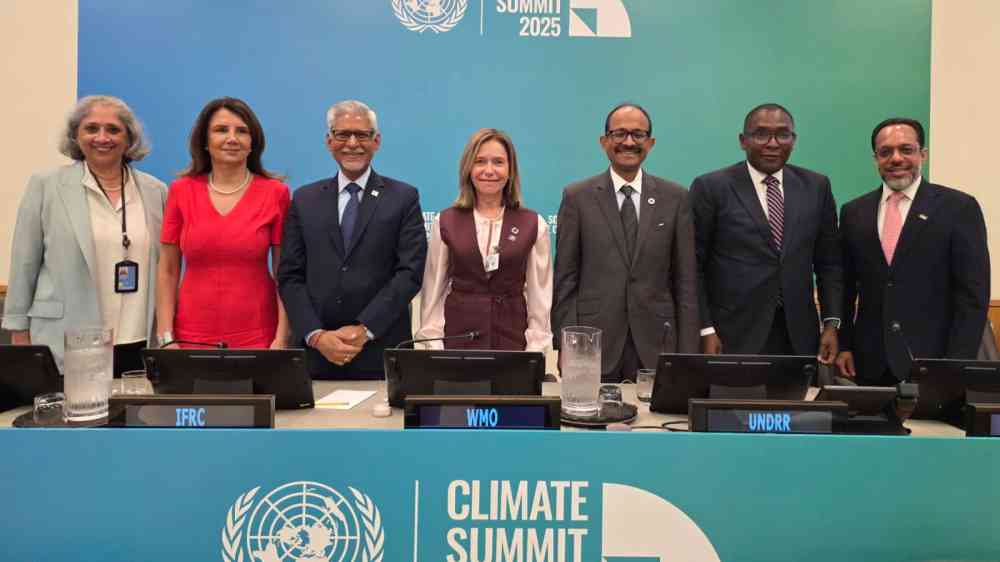
New York, 22 September 2025 – A broad coalition of national and local governments, regional partners, civil society, philanthropy, and the private sector came together at the United Nations General Assembly for the High-Level Solutions Dialogue on Accelerating Early Warning and Extreme Heat Solutions. Convened alongside the UN Secretary-General’s Climate Summit, the Dialogue highlighted the urgent need to expand life-saving early warning systems and confront the rising risks of extreme heat.
As global temperatures rise, floods, droughts, storms, wildfires, and heatwaves are claiming more lives, devastating ecosystems, and undermining sustainable development. Early warning systems have proven to be among the most effective tools for reducing disaster mortality and economic losses, while extreme heat is emerging as one of the most underestimated but deadliest hazards of our time. Together, these challenges demand solutions that combine technology, governance, financing, and inclusion.
The Dialogue was co-convened by the UN Secretary-General’s Climate Action Team, UNDRR, WMO, IFRC, ITU, UNEP, and Brazil, bringing together governments, cities, international organizations, and civil society to identify high-impact solutions that can be scaled up and replicated ahead of COP30 in Belém.
Accelerating Early Warnings for All
Participants emphasized that multi-hazard early warning systems (MHEWS) are among the most cost-effective tools to reduce climate risks, saving lives and preventing escalating losses across economies and societies. Yet global coverage remains uneven, leaving millions without timely and actionable alerts.
Speakers called for stronger national ownership and capacity-building at the community and local levels, embedding early warning systems into climate and development strategies, and integrating them into national budgets to ensure long-term sustainability. They also highlighted the importance of sustained financing, regional cooperation, and innovation to close existing gaps, particularly in small island developing states, least developed countries, and fragile contexts.
Participants called for:
- Embedding early warning systems into Nationally Determined Contributions (NDCs) and National Adaptation Plans (NAPs) to support adaptation planning and secure access to climate finance.
- Securing long-term investment through national budget allocations, complemented by international finance.
- Strengthening impact-based warnings, last-mile communication, and anticipatory action.
- Improving coordination of international development assistance to align financing with national priorities and strengthen data cooperation.
- Harnessing innovative technologies and partnerships to close persistent coverage gaps.
In his opening remarks, Kamal Kishore, Special Representative of the UN Secretary-General for Disaster Risk Reduction, reminded participants that technology alone cannot close early warning gaps:
“We must remember that effective early warning systems are a whole-of-society function. This means investing in building trust with the public, strengthening coordination, and ensuring no one is left behind.”
Addressing extreme heat
Extreme heat has become one of the deadliest and most corrosive climate hazards, straining health systems, disrupting utilities and services, damaging infrastructure, ecosystems and economies and disproportionately impacting the most vulnerable.
The Dialogue amplified the Secretary-General’s warning that extreme heat poses a systemic threat to development, demanding urgent, integrated responses. Governments and partners emphasized the importance of whole-of-society responses, national heat action plans, urban cooling, and nature-based solutions.
Participants called for:
- Accelerating heat action plans that identify and protect vulnerable populations.
- Expanding passive and cleaner cooling solutions in cities.
- Reinforcing health, labor, and social protection systems to protect lives and livelihoods.
- Leveraging innovative financing instruments, such as impact bonds, to scale proven solutions.
- Mobilizing global momentum through the “Beat the Heat” initiative, launched by the Brazil COP30 Presidency and UNEP to scale up coordinated national responses.
Speakers urged that scaling investment in heat solutions requires integrated policy and decision-making, aligning climate action with urban planning and social protection systems:
“The greatest barrier to scaling investment in heat risk solutions that we see is the lack of integrated planning that connects climate risk, urban development and social protection,” said a representative of Freetown.
Looking ahead
The Dialogue concluded with a strong consensus on the need for intentional, inclusive, and accelerated action to scale up early warning systems and address extreme heat as global adaptation priorities. The Dialogue reaffirmed that universal early warning coverage and decisive measures on extreme heat must advance together. These priorities are essential to protecting lives, safeguarding development gains, and accelerating the 2030 Agenda.
Commitments to strengthening extreme heat risk governance will support the testing and application of the UNDRR and World Meteorological Organization (WMO)-led heat governance framework and toolkit in multiple countries, from high-income (HIC) to least developed (LDCs), and cities in the months and years to come.
By spotlighting scalable solutions and mobilizing political and institutional momentum, the Dialogue reinforced that early warnings and heat action are essential pillars of climate resilience and sustainable development in the age of extremes.