
Accelerating local disaster risk reduction in the Caribbean through the work of Making Cities Resilient 2030
Effective disaster risk reduction cannot be achieved without the engagement and empowerment of those at the forefront of disaster and climate risks-namely, local governments and communities. Yet, the Midterm Review of the Sendai Framework for Disaster Risk Reduction has revealed persistent gaps in local implementation. Many small island developing states (SIDS) identified a near complete absence of local government and community involvement in disaster risk reduction planning, highlighting the urgent need for accelerated efforts as the 2030 deadline approaches.
With less than five years left to achieve the targets of the Sendai Framework, local governments are increasingly taking the lead in disaster risk reduction and climate resilience actions. As global challenges grow in complexity and uncertainty, a coordinated, multilevel approach to international cooperation is essential to support cities and municipalities in addressing systemic risks that cross geographic and sectoral boundaries.
In response to the growing need for localization of the Sendai Framework, the Making Cities Resilient 2030 (MCR2030) initiative provides a comprehensive roadmap for enhancing local resilience through advocacy, knowledge-sharing, city-to-city learning networks, and partnerships. The MCR2030 initiative has successfully supported multiple cities and local areas worldwide in advancing their resilience goals.
Collectively, these insights sounded the clarion call for increased targeted interventions to strengthen disaster risk reduction at the local level.
Lens on the Caribbean
The Caribbean region, home to approximately 50% of the world’s small island developing states, presents a complex risk landscape characterized by multi-hazard exposures, increasing susceptibility to climate change, and small, open economies that render them particularly susceptible to external shocks. As Caribbean economies continue to recover from the impacts of the COVID-19 pandemic, along with devastating impacts of recent hazard events, such as Hurricane Beryl (2024), efforts are being intensified to comprehensively address disaster risk in all its dimensions. The goal is to protect people, their livelihoods, the environment and local economies.
Caribbean countries continue to make significant strides in developing and implementing national disaster risk reduction strategies, commonly referred to as country work programmes. Progress is also underway in strengthening multi-hazard early warning systems across several Caribbean countries through the efforts of the Early Warning for All initiative. However, challenges remain in reaching and integrating the grassroots level –specifically, local communities.
In this context, Phase II of the Human Security Joint Programme was initiated in 2024 with the objective of “Promoting a human security approach to disaster displacement, environmental migration and disaster risk reduction in the Caribbean Region.” Funded by the United Nations Trust Fund for Human Security (UNTFHS) and co-led by the International Organization for Migration (IOM) and UNDRR, these organizations partnered with regional and local development partners to implement MCR2030 tools and methodologies across four Caribbean communities to support the design of Local Disaster Risk Reduction and Resilience Action Plans.
MCR2030 as a vehicle to mainstreaming the human security approach and advancing disaster risk reduction at the local level
Beginning in November 2024 in St. John’s Antigua, and followed by St. Joseph, Barbados; St. James Jamaica; and culminating in Old Road, St. Kitts and Nevis, in April 2025, UNDRR partnered with local stakeholders to implement the Disaster Resilience Scorecard, the Displacement Addendum, and the Multi-Hazard Early Warning Systems Addendum, in a series of workshops aimed at informing the design of Local Resilience Plans for these areas.
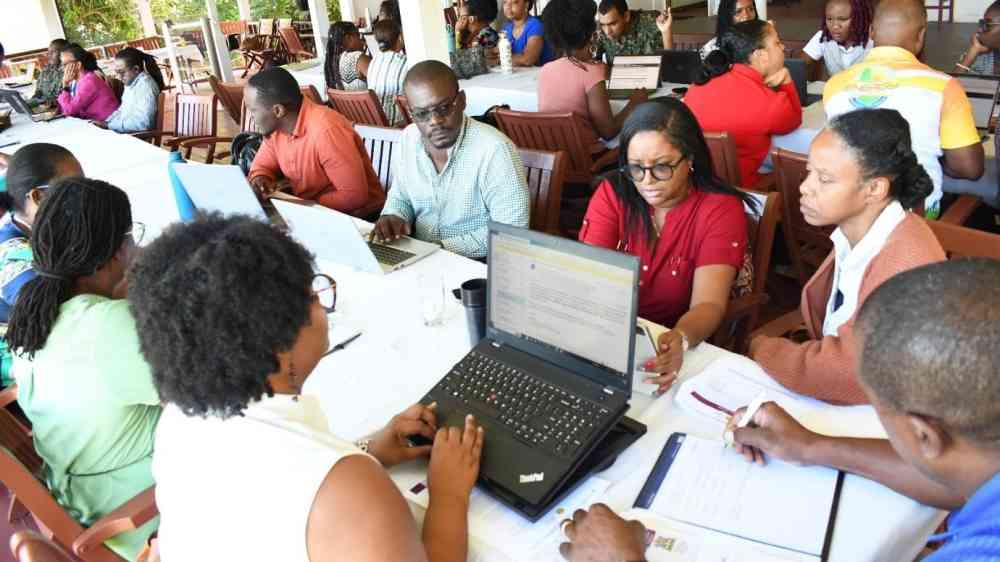
Across the four workshops, over 100 participants from government, the private sector, development partners, civil society, and local communities were trained to apply the MCR2030 tools and develop local resilience actions. The sectors participating included environment, planning, infrastructure, security forces, social services, public utilities, community development, finance, statistics, information services, tourism, and agriculture. These workshops enhanced local capacities to apply MCR2030 tools for disaster risk reduction and resilience planning, fostered cross-stakeholder sharing of good practices, and empowered diverse stakeholders across sectors to meaningfully participate and take ownership of their roles in disaster risk reduction and resilience planning.
As Captain Samrodia of the Barbados Defence Force shared: “The Barbados Defence Force is a key stakeholder of the national emergency architecture, and we must be resilient to support the other nodes of the national emergency architecture, which helps us to be prepared in the event of the disaster. Having St. Joseph build its local resilience, will definitely assist nationally, so we meet a certain level of preparedness.”
The voice of community members and vulnerable groups were critical to the discussions and outcomes of the workshops. Ms. Rozanne Emanuel of the St. John’s Community Emergency Response Team, sharing her vision for St. John’s, Antigua, highlighted “Somewhere that can evolve and adapt to the changes around us (whether environmental, social, economic) and whatever the challenges may be, the city will be able to sustain itself.” In St. Kitts and Nevis, participants further emphasized the importance of developing strategic partnerships across stakeholders, especially within the community, and working collaboratively for the benefit of all.
In addition, to building local stakeholders’ capacities for disaster risk reduction, the initiative supported the development of localized, inclusive actions aimed at reducing disaster risk and bolstering resilience in these local areas. These plans echo the principles of human security, rooted in people-centred, comprehensive, context-specific and prevention-oriented solutions that strengthen the protection and empowerment of people and communities.
To ensure sustainability of these initiatives, UNDRR has committed to continued partnerships with local stakeholders to support the implementation of these plans and the continued application of MCR2030 tools in the Caribbean. To facilitate this, the joint programme is also supporting the development of a Training of Trainers aimed at structuring the design of local strategies for disaster risk reduction, leveraging the tools of MCR2030.
This recent work in the Caribbean has proven the flexibility and scalability of MCR2030 in supporting local resilience planning and mainstreaming the human security approach. Although MCR2030 has the nomination of cities, it targets localities more broadly and can be implemented in very local contexts, such as districts and communities, to inform the development of local resilience governance plans. By ensuring community inclusion and creating localized, comprehensive action plans, this initiative has supported Caribbean communities and countries take significant steps towards their disaster risk reduction and resilience goals.