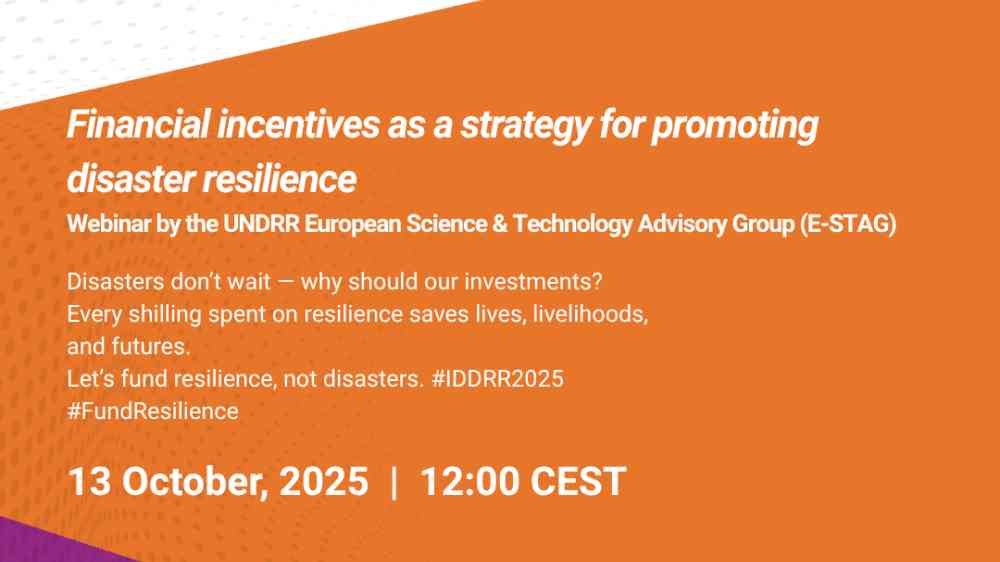
Financial incentives as a strategy for promoting disaster resilience
- English
International Day for Disaster Risk Reduction 2025: Fund Resilience, Not Disasters 13 October 2025
#ResiliencePays #DRRday
Under the theme "Fund Resilience, Not Disasters", International Day for Disaster Risk Reduction 2025 calls for a decisive shift: fund resilience now to avoid paying for disasters later.
Webinar Title: Financial incentives as a strategy for promoting disaster resilience
Date : 13 October 2025
Time : 12:00 CEST
Weblink : https://undrr.zoom.us/webinar/register/WN_WFJa9Qw7T6uZ8fKv6IpJlA
Background:
Despite the consistent attention paid to the need to mitigate disaster risks over the years, the impact and economic damages of disasters have grown continuously. Investments in disaster risk reduction (DRR) have not kept pace with the rapidly changing environment and many economic and investment plans remain blind to disaster and climate-related risks. In addressing these challenges, incentivising and rewarding risk-informed local and national investments in resilient practices has been identified as a mechanism where risks can be transformed into opportunities supporting resilience building, including through utilizing insurance instruments in this process. In addition, recently published priority actions to enhance readiness for resilient recovery include: "Secure and enable predictable, inclusive preparedness and recovery financing", as one of the ten actions, which highlights the need for Resilient Recovery to continue to ensure that financial perspectives and needs are fully integrated by means of strengthening public financial management systems and developing pre-arranged financial instruments. Within this context, this session provides a discussion, with a number of best practice examples, on exploring the use of financial incentives to enhance investments in disaster risk reduction and recovery and towards increased resilience.
Session Outline:
Session Moderator: Prof. Dilanthi Amaratunga
- Opening: Fund Resilience, Not Disasters: Making buildings disaster resilient - Mr. Sebastien Penzini, Deputy Chief UNDRR Regional Office for Europe and Central Asia
- Financial incentives in promoting disaster resilience - Prof. Dilanthi Amaratunga
- Methods and approaches for financial incentives to promote disaster resilience: Best practices from the housing sector - Dr. Shavindree Nissanka
- Closing the financial protection and recovery gap - role of advanced insurance instruments - Dr. Jaroslav Mysiak
- Key challenges in ensuring financing for preparedness and recovery - Mr. Christian Resch
- Q&A and the way forward
Expected Outcomes:
- Improved understanding on mechanisms to increase funding for disaster risk reduction and recovery provided
- Strategies to incentivize local communities to invest in DRR presented
- Methods and approaches will provide a basis for the resilience funds to be distributed strategically so that optimum disaster resilience can be achieved
- Re-emphasise the need to ensure all forms of development and investments are risk-informed
Target audience:
- National and Local government - National Governments: Policymakers and budget planners to prioritise DRR funding and ensure development plans are risk-informed.
- Private Sector Leaders: Businesses, investors, and financial institutions
- International Donors and Humanitarian Agencies: Development and humanitarian actors are encouraged to scale up funding for DRR
- Civil Society and Academia: Advocates, researchers, and practitioners to drive innovation, provide evidence for risk-informed investments, and hold stakeholders accountable for implementing DRR strategies.
Speaker bios
Dr. Jaroslav Mysiak is a Principal Scientist at the Euro-Mediterranean Centre on Climate Change. Jaroslav's research focuses on risk assessment and governance, including behavioral responses to risks and risk reduction measures, transformative social change, environmental economics, sustainable finance, climate adaptation, and services. He is a member of the UNDRR European Science and Technology Advisory Group (E-STAG) and coordinator of the Horizon Europe project Nature for Insurance, Insurance for Nature (NATURANCE).
Mr. Christian Resch is Managing Director of the Disaster Competence Network Austria, a national platform that connects science, policy, and practice in disaster research. He combines extensive research-management leadership with field experience as a professional military officer and operational expert for the European Union Civil Protection Mechanism and the United Nations Disaster Assessment and Coordination team. He holds master's degrees in military leadership and industrial process safety and is completing a PhD at Graz University of Technology.
Prof. Dilanthi Amaratunga is the Professor of Disaster Risks and Climate Resilience at Loughborough University UK, and a leading international expert in disaster resilience with an extensive academic career. Her research focuses on preparedness for disaster response, recovery and reconstruction, early warning and communication, disaster resilience cities, and built environment dimensions of climate change and sustainability. Dilanthi is recognised for her career-long impact and is placed among the global top 2% of influential scientists by Elsevier BV, Netherlands and Stanford University, USA. She is a member of the European Commission and UNDRR's European Science & Technology Advisory Group, a Member of the UNDRR Making Cities Resilient 2030 (MCR2030) Regional Coordination Committee for Europe, and an Expert member of the ICG/IOTWMS WG-1 on Tsunami Risk, Community Awareness & Preparedness.
Dr. Shavindiree Nissanka is a Senior Lecturer at Sri Lanka Institute of Information Technology (SLIIT). She recently completed her PhD research at the University of Huddersfield, UK, focusing on the use of Financial Incentives for promoting Disaster Resilient Housing. She was the lead researcher for the BEACON (Built Environment Learning for Climate Adaptation) project, an EU-funded research collaboration. Dr. Nissanka has presented her work at numerous international conferences and has published on Disaster Resilient Properties, Disaster Resilient Building Codes, and the Integration of Disaster Resilience for Sustainable Construction. In 2023, she was named one of the Women of the Future - 50 Rising Stars in Environmental, Social and Governance (ESG) in the United Kingdom.