
Arab States strengthen regional cooperation on urban resilience and risk-informed development
- Arabic
- English
As rapid urbanization, climate change, infrastructure expansion, environmental degradation and population growth increase the exposure of Arab cities to hazards, urban resilience has become central to protecting people, public investments and sustainable-development gains. Responding effectively requires stronger coordination between national and local authorities, greater use of risk information and the integration of resilience into planning, governance, infrastructure and investment decisions.
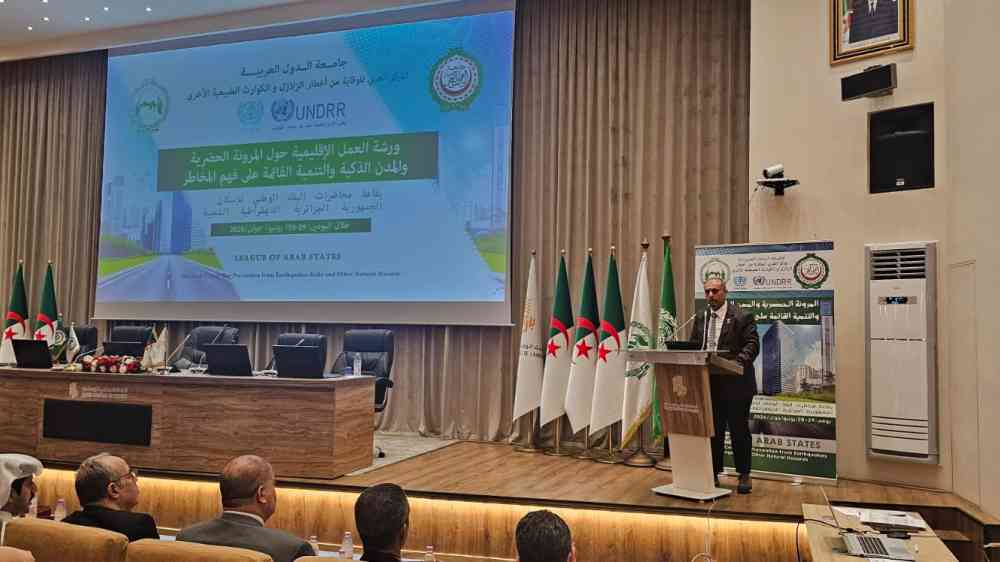
Representatives of governments, regional organizations, United Nations agencies, technical institutions and city authorities gathered in Algiers for a three-day regional workshop on urban resilience, smart cities and risk-informed development. The event was organized by the League of Arab States, the Arab Centre for the Prevention of Earthquake and Other Natural Disasters, UNDRR, UN-Habitat and regional partners. It was held alongside the inaugural meeting of the Arab Urban Resilience Committee.
The workshop provided a platform for exchanging national experiences and identifying practical approaches for integrating disaster-risk reduction into urban policies and investments. Participants discussed governance, resilient infrastructure, sustainable finance, nature-based solutions, smart-city approaches, digital innovation and community engagement. A dedicated UNDRR session presented the Making Cities Resilient 2030 roadmap, the Disaster Resilience Scorecard for Cities, resilience-action planning, disaster-risk financing, loss-and-damage data systems and the Early Warnings for All initiative.
Experiences from Algeria, Egypt, Oman, Lebanon, Jordan, Bahrain and Palestine demonstrated how countries and cities are translating international commitments into locally relevant action. A major outcome was the establishment of the leadership structure of the Arab Urban Resilience Committee, with Oman selected as Chair and Algeria and the State of Palestine serving as Vice-Chairs. The Committee will facilitate collaboration, knowledge exchange and the implementation of risk-informed urban policies across the Arab States. By linking global frameworks with national policies and local action, the workshop reinforced the importance of resilient cities in advancing the Sendai Framework and the Sustainable Development Goals.