1. Home
  2. Our work
Capacitación
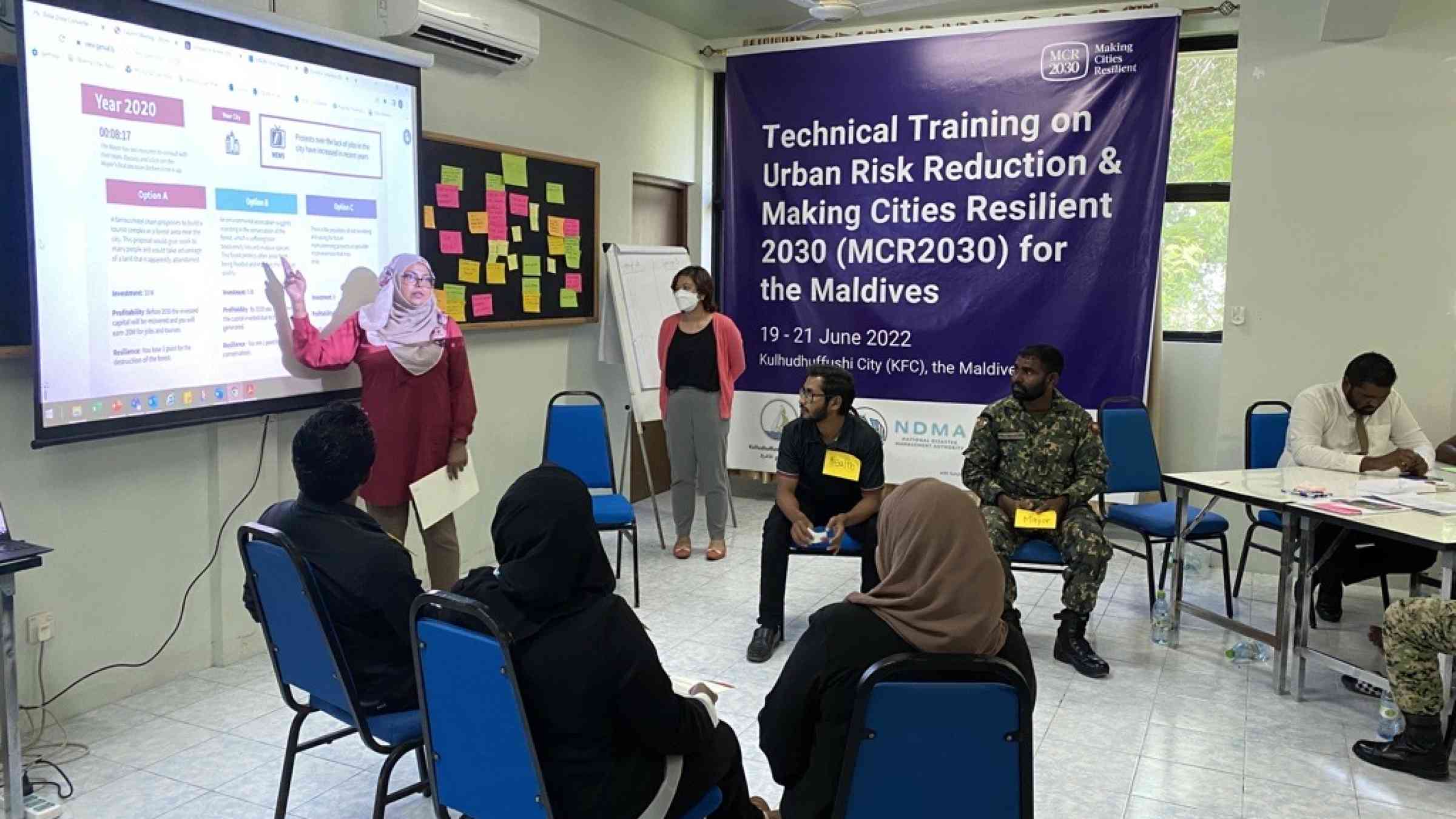
UNDRR trabaja a nivel mundial con gobiernos, instituciones y con el sector privado y la sociedad civil para capacitar e incorporar la reducción del riesgo de desastres y la adaptación al cambio climático en el desarrollo sostenible.

El riesgo es un asunto de todas las personas. UNDRR no puede reducir el riesgo de forma solitaria.

El Global Education and Training Institute (GETI) de UNDRR, situado en Incheon, República de Korea, trabaja globalmente con los gobiernos, instituciones, el sector privado y la sociedad civil para fomentar la capacidad de incorporar la reducción del riesgo de desastres y la adaptación al cambio climático en el desarrollo sostenible.

A través de nuestra campaña Desarrollando Ciudades Resilientes, convocamos y apoyamos el aprendizaje interurbano para fortalecer la resiliencia y proporcionar apoyo para la capacitación de las instituciones nacionales que trabajan en temas de resiliencia, apoyando el intercambio de mejores prácticas.

Contáctenos para aprender más sobre nuestros cursos personalizados bajo solicitud.


Próximos programas de formación UNDRR

No results found.

Capacitaciones bajo demanda

Case study
This case study demonstrates how disaster losses and damage data can be applied to understand child displacement risk and inform forward-looking planning.
  • United Nations Children's Fund (UNICEF)
  • United Nations Office for Disaster Risk Reduction (UNDRR)
Training course
Online
The course provides journalists and media professionals with a comprehensive foundation in disaster risk reduction and practical guidance for reporting in ways that increase risk understanding, empower communities, and build resilience.
  • United Nations Office for Disaster Risk Reduction (UNDRR)
Case study
Ubicación: Ethiopia Kenya
In Kenya and Ethiopia, the EarlyWarning4IGAD project is piloting an approach for impact-based early warning for flood, focusing on the impacts for people and drought, concentrating on the impacts on crops and subsistence farmers.
  • United Nations Office for Disaster Risk Reduction (UNDRR)
Case study
Ubicación: Brazil Cambodia India Solomon Islands
Countries like Brazil, the Solomon Islands and Cambodia are strengthening MHEWS through mobile-based strategies tailored to local contexts and resource realities.
  • United Nations Office for Disaster Risk Reduction (UNDRR)
Case study
Ubicación: Ecuador Haiti India
High tech, low tech, and no tech solutions are implemented in Ecuador, Haiti, and India to make early warnings more understandable, inclusive, and actionable in local communities.
  • United Nations Office for Disaster Risk Reduction (UNDRR)
  • The Climate Risk & Early Warning Systems Initiative (CREWS)
Case study
Ubicación: Timor-Leste SIDS (Small Island Developing States) LDCs (Least Developed Countries)
UNDRR led a comprehensive assessment of loss and damage data collection practice in Timor-Leste that informed a methodology and procedural guidance for improved accounting for disaster loss and damage.
  • United Nations Office for Disaster Risk Reduction (UNDRR)
Case study
Ubicación: Libya Malawi
In climate-vulnerable regions like Malawi and Libya, community-based monitoring initiatives are driving improvements in EWS capabilities.
  • United Nations Office for Disaster Risk Reduction (UNDRR)
Case study
Ubicación: Barbados
To support public dialogue about EWS, facilitate mass communication, and ensure the timely dissemination of critical information, the Barbados Department of Emergency Management formalised Memorandums of Understanding with major broadcasting networks.
  • United Nations Office for Disaster Risk Reduction (UNDRR)
Case study
Recent developments around the Common Alerting Protocol (CAP) - a digital format for delivering consistent, multi-channel alerts - reflect growing global momentum to standardise and strengthen early warning communication.
  • United Nations Office for Disaster Risk Reduction (UNDRR)
  • International Federation of Red Cross and Red Crescent Societies (IFRC)
Case study
Ubicación: Mali Sudan Americas Cambodia
Evidence on inclusive approaches in MHEWS is growing signalling increased momentum across diverse regions, with initiatives in Mali, Sudan, Cambodia, and Latin America and the Caribbean demonstrating how equity-driven strategies can strengthen MHEWS.
  • United Nations Office for Disaster Risk Reduction (UNDRR)
  • The Climate Risk & Early Warning Systems Initiative (CREWS)

Muestras de cursos

Relacionado