
ONEA and GETI newsletters
Quarterly UNDRR ONEA & GETI updates on activities and impact are available in our newsletter.
Current edition
UNDRR ONEA and GETI Newsletter 49: Jan-Mar 2026
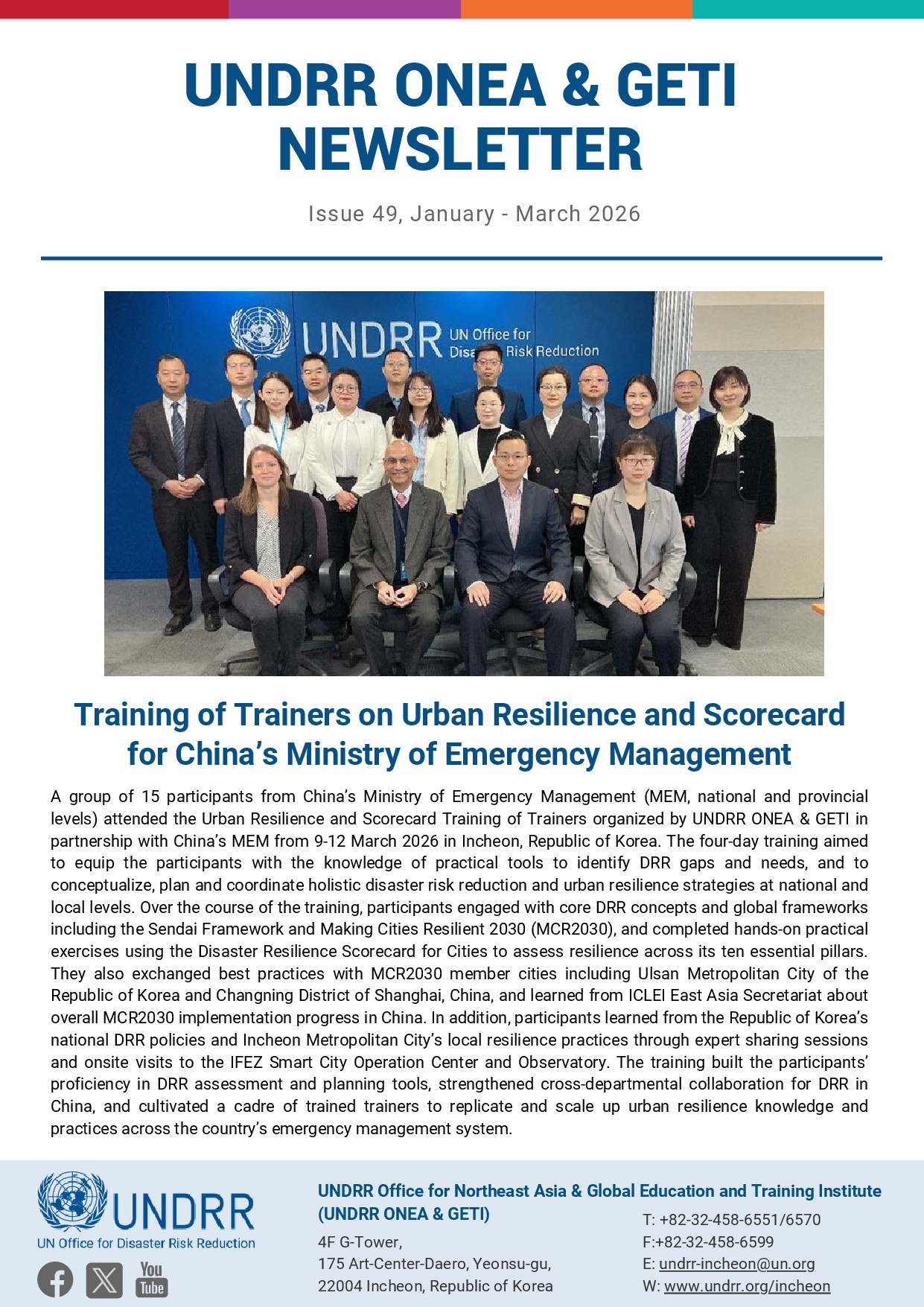
In the first quarter of 2026, UNDRR ONEA and GETI continued to advance disaster risk reduction (DRR) and urban resilience capacity building across Asia, partnering with governments, institutions, and the private sector to strengthen local and national preparedness. In Bangladesh, an online training program was delivered in collaboration with the Bangladesh Public Administration Training Centre, embedding DRR principles into public sector learning. In India, Raipur expanded its DRR capacity through a partnership with KPMG India and UNDRR GETI, demonstrating the growing role of private sector engagement in resilience-building. China saw two significant initiatives: a community-focused disaster risk reduction and urban resilience capacity building event in Dengfeng City, and a Training of Trainers program for China's Ministry of Emergency Management on urban resilience and the City Resilience Scorecard — equipping national officials to cascade knowledge at scale. Meanwhile, Mongolia strengthened its planning frameworks through a dedicated workshop on tools for disaster risk reduction. Together, these activities reflect UNDRR ONEA-GETI's sustained commitment to building resilient cities and communities through tailored, multi-stakeholder capacity development across the region.
Previous editions
2025
- UNDRR ONEA & GETI Newsletter 48: Oct-Dec 2025
In the last quarter of 2025, UNDRR ONEA & GETI, together with partners across the region, advanced disaster risk reduction through a wide range of initiatives. Highlights included the successful organization of the International Disaster Resilience Leaders Forum in Incheon, which convened more than 400 participants from 24 countries to strengthen global cooperation under the Sendai Framework; multiple regional and national training programmes in cities such as Incheon, Bangkok, Delhi, Singapore, and Xuzhou, focusing on topics including seismic safety, extreme heat, climate change adaptation, resilient recovery, and the use of advanced science and technology; and targeted capacity-building efforts for sub-national and local governments under the MCR2030 initiative, including midterm reviews of city DRR plans, urban resilience orientations, and hands-on application of tools such as the Disaster Resilience Scorecard for Cities. The newsletter also highlights inclusive and forward-looking approaches, such as training programmes empowering organizations of persons with disabilities, youth engagement through the “Voices of the Future” session, public-private collaboration promoted by ARISE networks, and South-South and triangular cooperation through ASEAN-ROK programmes and study visits to Germany. Together, these activities demonstrate how knowledge exchange, peer learning, and partnerships among governments, international organizations, academia, and the private sector are translating global frameworks into concrete local action for safer, more inclusive, and more resilient cities.
Find out more - UNDRR ONEA & GETI Newsletter 47: Jul-Sep 2025
In the third quarter of 2025, UNDRR ONEA & GETI, together with partners across the region, advanced disaster risk reduction through a wide range of initiatives. Highlights included the successful visit of SRSG Kamal Kishore to the Republic of Korea, where he also engaged with university students at the Incheon Global Campus, and the demonstration of Korea’s school safety programme in Gwangmyeong. Across Asia, countries came together to strengthen resilience—Incheon City convened a localized disaster response seminar, while the TCS-UNDRR Inter-Regional Dialogue facilitated knowledge exchange on technology for DRR between Northeast and Southeast Asia. Urban resilience and early warning capacities were strengthened through training and workshops in Nagaland, Mumbai, and the Philippines, as well as initiatives in Baguio City promoting disability-inclusive DRR and efforts to enhance gender-responsive systems against extreme heat. The Kyoto Symposium emphasized protecting cultural heritage, while the use of the MCR2030 dashboard deepened city engagement. Youth voices also contributed, with Inhwa Girls’ High School presenting their research on the climate crisis. Together, these activities reflect the growing momentum for inclusive, technology-driven, and locally grounded approaches to resilience in the region.
Find out more - UNDRR ONEA & GETI Newsletter 46: Apr-Jun 2025
UNDRR ONEA & GETI activities in Q2, 2025 highlights: Korea's contributions were showcased at the 8th GP2025, including school safety training and smart city operations for Incheon educators, technical workshops in Togo on DRR tools and early warning systems, innovative masterclasses on resilient housing and infrastructure, and training programs for urban and private sector resilience. Collaborative events such as the UNDRR–WCCD workshops in Vaughan and Ajman emphasized data-driven resilience, while webinars with CCFLA and MCR2030 explored climate finance and project implementation. Other notable efforts included advancing disability inclusion in DRR, an online workshop on risk-informed governance and climate finance co-hosted with UNPOG and UNITAR, and a partnership with Brihanmumbai Municipal Corporation and KPMG India to bolster urban resilience in Mumbai.
Find out more - UNDRR ONEA & GETI Newsletter 45: Jan-Mar 2025
UNDRR ONEA & GETI activities in Q1, 2025 highlights: In Northeast Asia, DRR training with the Trilateral Cooperation Secretariat (TCS) emphasized integrating a DRR perspective into trilateral collaboration. The global launch of the Disaster Displacement Addendum to the Scorecard marked a major step forward in addressing displacement risks. In Central Asia, the CCFLA Local Hub Forum explored project preparation synergies to accelerate energy-efficient building renovation. A regional Scorecard training for Asia-Pacific strengthened urban resilience planning and assessment. Meanwhile, the 2025 UNDRR–UNOSSC–PAHO Joint Certificate Training Program focused on leveraging South-South and triangular cooperation to drive inclusive, tech-based solutions for urban health and DRR, with its first session dedicated to disability inclusion in DRR strategies.
Find out more
2024
- UNDRR ONEA & GETI Newsletter 44: Oct-Dec 2024
UNDRR ONEA & GETI activities in Q4, 2024 highlights: International Disaster Resilience Leaders Forum 2024, which convened global stakeholders to share strategies for building resilience through education, digital tools, and public-private partnerships; initiatives focused on advancing resilience in education such as Climate Resilience for Education System Scorecard and Comprehensive School Safety Framework; innovative masterclasses on AI, digital finance, and urban resilience tools demonstrated technology’s role in sustainable development; new tools were introduced to enhance inclusive and evidence-based DRR planning through the Multi-Hazard Early Warning Systems Addendum and Disability-Inclusive Disaster Risk Reduction e-Learning course, while regional training workshops in Africa, Thailand, and Mongolia empowered governments to integrate resilience strategies into disaster management and climate adaptation plans.
Find out more - UNDRR ONEA & GETI Newsletter 43: Jul-Sep 2024
UNDRR ONEA & GETI activities in Q3, 2024 highlights: the Trilateral Youth Summit engaging students from China, Japan, and Korea in disaster resilience and climate adaptation; urban resilience training in Bangladesh using the UNDRR Climate Resilience Scorecard; a DRR course in Singapore focusing on the Sendai Framework and whole-of-government approaches; workshops in the Maldives strengthening the Greater Male’ City DRR strategy; ASEAN collaborations exploring Korea’s disaster management technologies; the launch of the China Resilient Cities Report showcasing strategies for climate resilience; and innovative tools such as gender-responsive planning frameworks and disaster displacement addendums.
Find out more - UNDRR ONEA & GETI Newsletter 42: Apr-Jun 2024
UNDRR ONEA & GETI activities in Q2, 2024 highlights: China-Japan-Korea Interregional Dialogue 2024 and Workshop on Multi-Hazard Early Warning; Capacity development for British Columbia to build DRR strategy; DRR in humanitarian action; MCR2030 and urban resilience activities in Incheon, Gold Coast, Bontang, Pakistan, Nepal and Namibia; Korean School Safety Programme activities in Korea and Indonesia; Participation in the Schools2030 Global Forum 2024 and 2024 UN Public Service Forum; and more along with introduction to new publications and tools by UNDRR ONEA and GETI and information for access to online self-paced training courses.
Find out more - UNDRR ONEA & GETI Newsletter 41: Jan-Mar 2024
UNDRR ONEA & GETI activities in Q1, 2024 highlights: Korean School Safety Programme in schools of Nepal; training for managers of ASEAN member states; Bangkok city building up a team for resilience assessment; CJK and ASEAN youth engagement; private sector training for Fiji Airways staff; Oman learning from Incheon as MCR2030 Resilience Hub; and more along with introduction to new publication and tools by UNDRR ONEA & GETI.
Find out more
2023
- UNDRR ONEA & GETI Newsletter 40: Oct-Dec 2023
UNDRR ONEA & GETI activities in Q4, 2023 highlights: Urban resilience focusing on disability inclusion; Roll out of MCR2030 in Republic of Korea; City-to-City exchange in Northeast Asia; Expansion of the Korean School Safety Programme in South and Southeast Asia; Launch of training for DRR technology; Disability inclusion actions in Philippines and Uganda; Budget Tagging for DRR & CCA; Financing for urban resilience; and more.
Find out more - UNDRR ONEA & GETI Newsletter 39: Jul-Sep 2023
UNDRR ONEA & GETI activities in Q3, 2023 highlights: International Disaster Resilience Leaders Forum Incheon 2023; Bhutan cities pioneering disability inclusion; Experience sharing and learning in Northeast Asia for China, Japan, Korea and Mongolia; Newly published guidance tools and trainings for local DRR and humanitarian action; and more.
Find out more - UNDRR ONEA & GETI Newsletter 38: Apr-Jun 2023
UNDRR ONEA & GETI activities in Q2, 2023 highlights: Capacity development for MCR2030 and local resilience in Korea, China, Thailand, Nepal, Bhutan and Fiji; Training for risk-informed governance; National capacity development for the Caribbean and African countries; Joint training on south-south cooperation for post-COVID era including public health resilience; Roll out of Korean School Safety Programme through training of trainers; and more.
Find out more - UNDRR ONEA & GETI Newsletter 37: Jan-Mar 2023
In Q1 of 2023, UNDRR ONEA & GETI contributions in facilitating discussions on public health resilience. Main activities in Q1 also include: Sharing Experiences on the Korean School Safety Programme; Introduction to disaster risk reduction for the private sector in Indonesia; participation in the SUNY Korea DTS Seminar Series on using technology to reduce disaster and climate risks; joint effor with TCS to strengthen youth engagement in DRR in Northeast Asia; supporting journey to resilience for Fuvahmulah city which completed the disaster resilience selfassessment; and training for Comprehensive Climate and Disaster Risk Management (CRM) for the Arab States; and more.
Find out more
2022
- UNDRR ONEA & GETI Newsletter 36: Oct-Dec 2022
The last issue of 2022 highlights UNDRR ONEA & GETI contributions to strengthen school safety and education in Mongolia; focus on national capacity development in partnership with KOICA, Singapore and Madagascar; local capacity development in partnership with MCR2030 to Mongolia, Philippines, Thailand and SAARC member countries; support for MCR2030 activities with Resilience Hubs and to build urban resilience with inclusion of persons with disability; and more.
Find out more - UNDRR ONEA & GETI Newsletter 35: Jul-Sep 2022
This issue highlights contribution of UNDRR ONEA & GETI to the first International Disaster Resilience Leaders Forum 2022; kick-off of first training on thematic labelled bond for local government; risk-informed governance; MCR2030 in Maldives and China; MCR2030 and ARISE partnership; focusing on third joint training with UNOSSC, WHO and PAHO; activities for Northeast Asia including media training with TCS and highlighting of Korean School Safety Programme and MCR2030 in APMCDRR and more.
Find out more - UNDRR ONEA & GETI Newsletter 34: Apr-Jun 2022
This issue highlights UNDRR ONEA & GETI activities in Q2, 2022 including: Introduction of Korean School Safety Programme in Mongolia; Capacity development in Cambodia to support localization of SDG and resilience; WCCD highlighting ISO 37123 - Indicators for Resilient Cities; UNDRR ONEA & GETI's activities at the GP2022; Roll-out of Multi-Hazard Early Warning System (MHEWS) effectiveness indicators and more.
Find out more - UNDRR ONEA & GETI Newsletter 33: Jan-Mar 2022
UNDRR ONEA & GETI began capacity building journey for 2022 with Incheon city's Resilience Hub recognition; Training of mayors at the Asia-Pacific Mayors Academy; Singapore's DRR knowledge and experience shared to the Caribbean; MCR2030 Dashboard how-to guides; introduction of City Resilience Program to MCR2030 cities; Localizing SDGs in Thailand; Training of trainers for Philippines; and strengthening DRR for UN in Madagascar and more.
Find out more
2021
- UNDRR ONEA & GETI Newsletter 32: Oct-Dec 2021
UNDRR ONEA & GETI successfully closed 2021 with more than 4,700 persons reached through training. This issue highlights the UNDRR ONEA & GETI's activities in Q4 highlighting recognition of Incheon city as the first Resilience Hub in the Asia Pacific region. Q4 activities include continued commitments for Making Cities Resilient 2030; introduction and training for MCR2030 Dashboard; focus on integrating DRR and climate change adaptation into UN Sustainable Development Cooperation Frameworks, global effort for local resilience; celebration of IDDRR 2021 and World Tsunami Awareness Day; 30th anniversary of UN-ROK and more.
Find out more - UNDRR ONEA & GETI Newsletter 31: Jul-Sep 2021
This issue highlights the UNDRR ONEA & GETI's activities in Q3 focusing on the beginning of the race for MCR2030 sign-up in Asia-Pacific region, along with continued introduction of support provided by MCR2030 Core Partners. Establishing local resilience and emphasizing importance for school safety rolled out in the Republic of Korea, and capacity building activities took place to train experts for local resilience, UN country team in Egypt and ASEAN countries.
Find out more - UNDRR ONEA & GETI Newsletter 30: Apr-Jun 2021
This issue highlights the UNDRR ONEA & GETI's activities in Q2 with introduction to green bonds for resilience financing. Global and regional MCR2030 roll-outs took places and webinar series with core partners kicked off. Joint collaboration with Incheon City, CCS, CDRI, SCP, ASEAN, UN DCO, SUNY Korea, UNPOG, UNOSSC, WHO and more contributed for capacity development in national and local levels covering variety of subjects including COVID-19, DRR technology, tools for local resilience, school safety and Sendai Framework Monitoring.
Find out more - UNDRR ONEA & GETI Newsletter 29: Jan-Mar 2021
This issue highlights the UNDRR ONEA & GETI's activities in Q1 as well as introduction of the new MCR2030 and its Online Dashboard. Training of trainers for UN staff was organized for risk-informed UNSDCF, Webinar series in partnership with WHO is held for safe hospitals, Climate financing for green cities, partnership with CCS in Korea for safe schools, and building resilience for Asian region including ASEAN countries.
Find out more
2020
- UNDRR ONEA & GETI Newsletter 28: Oct-Dec 2020
This issue highlights the activities in Q4 and celebrates achievements throughout 2020 including celebration of 10th year anniversary of ONEA & GETI and the launch of MCR2030. Online trainings for local resilience and support for the implementation of Sendai Framework was held to reach out for capacity development, targeted trainings were also held with regional partners. Training package orientations on integrating DRR and CCA in UN Cooperation Frameworks was held, and Korean cities and schools moved their steps forward for building resilience.
Find out more - UNDRR ONEA & GETI Newsletter 27: Jul-Sep 2020
This issue highlights the activities in Q3 for continued effort for building resilience for local DRR planning and implementation, providing support for Sendai Monitoring in the Northeast Asia region, new tools and approaches for School safety in the Republic of Korea, focused training on exploring risk governance using frontier technology, training to raise awareness for local governments to be better respond and be prepared for future including Covid-19 and more.
Find out more - UNDRR ONEA & GETI Newsletter 26: Apr-Jun 2020
This issue highlights the online activities held in Q2 of 2020 as the world faced Covid-19 situation. Through online webinars and trainings, UNDRR ONEA & GETI continued to pursue our mandate for capacity development in disaster risk reduction and building resilience for local government by introduction and training on the Public Health System Resilience Addendum of the Disaster Resilience Scorecard for Cities; launching of Lessons from the Covid-19 pandemic webinar series with WHO and partners; covering aspects related to technology for responding to Covid-19; and continued effort for strengthening school safety in the Republic of Korea.
Find out more - UNDRR ONEA & GETI Newsletter 25: Jan-Mar 2020
This issue highlights the Incheon city becoming the first role model city in the Republic of Korea; meaningful outcomes for MCR2030; UN Country Team (UNCT) in Panama stepping forward on DRR; focus on urban resilience in India, China, Central America and the Carribean; Korean schools moving forward for nation-wide expansion of school safety training.
Find out more